How Much Does a Model Cost? The Apparel Founder's Guide to Photoshoot Budgets
Stop Overpaying for Hidden Fees! From $50 TFP to $6,000 Studio Shoots, Here's How Clothing Brands Spend Every Dollar Wisely.


For apparel sellers, dropping a new collection always hits the same bottleneck: the visual production budget. Many Shopify and Amazon fashion brands book a photo shooting model advertising a seemingly affordable $50/hr rate, only to realize that after factoring in studio rentals, photographers, and hidden agency fees, a single day of shooting has skyrocketed into a $3,200 invoice.
This gap between the advertised rate and the actual total is a massive pain point for e-commerce founders. The problem isn't your math—it's that the traditional photoshoot model relies on a pricing structure built to hide costs.
To help you protect your margins, this guide breaks down exactly how much it costs to do a photoshoot. We will unpack real-world costs by model tier, expose the hidden fee categories, and share merchant-tested budget hacks so you can maximize your visual ROI.
Key Takeaways:
Freelance models cost $55–$100/hr but require full founder-managed logistics and carry cancellation risk.
Agency-signed models run $800–$1,500+/day with a mandatory 20% agency booking fee on top.
Influencer models command a 5x premium but deliver dual value: product imagery + organic social distribution.
The three biggest hidden costs are photographer-model coordination friction, digital ad usage rights, and non-refundable vendor costs when a model cancels.
The chin-crop hack eliminates HMUA fees and reduces model costs for standard PDP shots.
The tactical split lets you use premium models for lifestyle content and lower-cost models for studio e-comm shots on the same day.
AI visual production tools like Koozee let apparel sellers generate on-model try-ons, product videos, and listing assets without the overhead of a traditional photoshoot.
The 2026 Reality Check: How Much Does a Model Cost? (By Tier)
Before you book anyone, you need to understand that "model cost" is not a single number. It's a tier system, and each tier comes with a completely different risk profile, workflow requirement, and total cost of ownership.
Here's the honest breakdown.
Freelance & Independent Models: $55 – $100 / Hour
This is the entry point most clothing startups reach for first. Freelancers are highly accessible and look cost-effective on paper, but their hourly rate only covers their time on set.
As the founder, you must personally handle all logistics: contract negotiations, scheduling, sample sizing adjustments, and the ever-present risk of last-minute cancellations. If a freelance model flakes, you are still on the hook for non-refundable studio and photographer fees.
Best for: Founders with tight budgets who have the time and experience to manage the full production process themselves.
Traditional Agency-Signed Models: $800 – $1,500+ / Day Rate
Agency models bring a level of professionalism and portfolio quality that freelancers often can't match. They show up on time, they know how to work with a camera, and their look is consistent and polished.
The day rate is just the starting point. Agency bookings almost always include a mandatory 20% agency booking fee on top of the model's rate. Add overtime clauses (typically billed in 30-minute increments after the contracted hours), and a "standard" agency day can quickly climb from $1,200 to $1,800 or more before you've paid for a single other line item.
Flawless portfolios, but the pricing structure is designed for large commercial clients with dedicated production budgets. For an independent clothing brand or a Shopify seller managing their own P&L, the agency model is often a significant financial stretch — especially when you're shooting multiple SKUs per season.
Best for: Established brands with dedicated production budgets and a clear creative brief that justifies the premium.
The "Influencer Premium" Models: The 5x Markup
Top e-commerce founders on platforms like Reddit regularly pay up to five times the standard rate to hire models who have 25,000+ active social media followers. While expensive upfront, the return on investment comes from dual-value distribution.
By securing a model and a micro-influencer in a single booking, you get high-end commercial imagery for your product pages plus native organic exposure to a pre-built target audience. Micro-influencers typically charge $500 to $1,500 per day, while mid-tier creators command $3,000 to $8,000+ for bundled shoot-and-post packages.
Best for: Brands that need both product imagery and social proof, and have the budget to negotiate a proper content agreement.
Watch Out! The 3 Hidden Money Pits That Bleed Apparel Photoshoot Budgets
Understanding the base rates is only half the battle. The real budget killers are the fees that don't show up until after the shoot — or worse, after you've already started running ads.
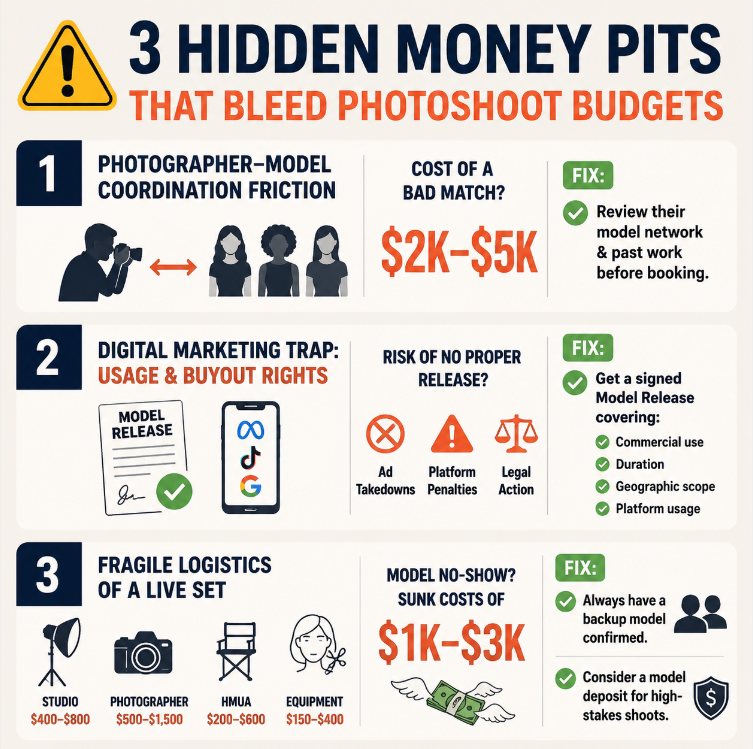
Pitfall 1: The Photographer-Model Coordination Friction
Handing a flat "all-inclusive" package fee to a photographer seems like the easiest path. One invoice, one point of contact, done.
The problem is that most photographers have a limited talent network. If their go-to models don't fit your brand's sample sizes, aesthetic, or demographic target, you end up with a full day of shooting that produces low-converting assets. The result: $2,000–$5,000 spent on a shoot you'll need to redo.
The fix: Always review the photographer's model network before booking. Ask to see examples of shoots with models who match your target customer profile. If they can't show you relevant examples, that's a signal.
Pitfall 2: The Digital Marketing Trap — Usage & Buyout Rights
This is the most expensive mistake apparel sellers make, and it happens constantly.
A base model rate covers the model's time on set. It does not automatically grant you the right to use those images in paid advertising. If you run Meta ads, TikTok ads, or Google Shopping campaigns using photos without a signed Model Release that explicitly covers commercial digital use, you're exposed to forced ad takedowns, platform penalties, and in some cases, legal action.
The fix: Before any shoot, get a signed Model Release that covers:
Commercial use in paid digital advertising
Duration of use (perpetual vs. time-limited)
Geographic scope (domestic vs. global)
Platform-specific usage (social media, e-commerce listings, paid ads)
Don't assume this is included in the standard booking agreement. It usually isn't.
Pitfall 3: The Fragile Logistics of a Live Set
When you're calculating how much do models get paid per shoot, you're only looking at one line item. But a live photoshoot is a multi-vendor operation, and every vendor has a non-refundable component.
Studio rental: $400–$800/day. Photographer: $500–$1,500/day. Hair & Makeup Artist (HMUA): $200–$600/day. Equipment rental: $150–$400/day.
If your model cancels the morning of the shoot — which happens more often than anyone in the industry likes to admit — you're looking at $1,000–$3,000 in sunk costs with nothing to show for it.
The fix: Always have a backup model option confirmed before shoot day. For high-stakes shoots, consider requiring a deposit from the model to create a financial commitment on their side.
3 Photoshoot Budget Hacks Used by High-Volume Apparel Brands
Now that you know where the money goes, here's how smart clothing sellers get more out of every production dollar.
Strategy 1: The "No-Face" Chin Crop Hack
This is one of the most widely used — and least talked about — tactics in high-volume e-commerce apparel photography.
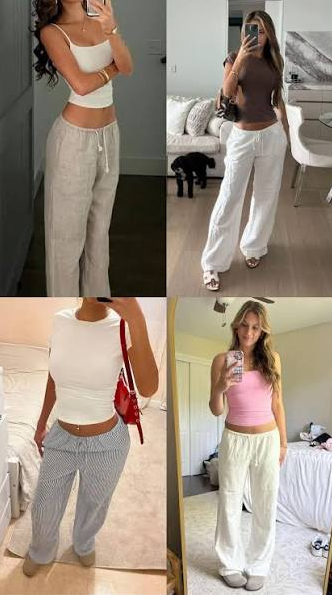
For standard Product Detail Pages (PDPs), many top-performing Shopify and Amazon sellers crop their imagery at the chin. The product is the hero. The model's face is irrelevant.
Why this matters for your budget:
When you don't need a model's face in the shot, you can hire body-accurate fitting models at a fraction of the cost of a full-face model. More importantly, you can eliminate HMUA fees entirely — no face means no hair and makeup requirements. On a typical shoot day, that's $200–$600 back in your pocket per session.
The math: If you're shooting 20 SKUs per season and running 4 shoot days, eliminating HMUA fees alone saves $800–$2,400 per season. That's real money.
Strategy 2: The Tactical Split — Lifestyle vs. Studio E-Comm Shots
Not all product images serve the same purpose, and not all images require the same model.
The play: Book your premium influencer-model for a tight 2-hour window at the start of the shoot day. Use that window exclusively for raw, ambient lifestyle imagery — the kind of content that performs on Instagram, TikTok, and in paid social ads. Then, for the remaining hours, switch to a lower-cost fitting model for your standard flat-lays, studio e-comm shots, and detail images.
Why it works: You get the high-value lifestyle content that justifies the influencer premium, without paying influencer rates for every single product shot. The studio e-comm shots — which are primarily functional, not aspirational — don't need a $1,500/day face. They need accurate fit representation.
Typical savings: 40–60% reduction in total model spend per shoot day, with no compromise on the quality of your hero lifestyle content.
Strategy 3: Shifting to Intelligent Digital Visual Workflows with Koozee
In an industry where a traditional full-scale commercial photoshoot routinely costs $3,500 to $6,000 per day, a growing number of smart clothing sellers are making a more fundamental shift: they are reducing their dependency on live shoots altogether. This isn't about cutting corners. It’s about recognizing that for the everyday visuals needed to scale an online store—model try-ons, scene variations, localized model swaps, and high-converting listing assets—modern AI production has officially become commercially viable.
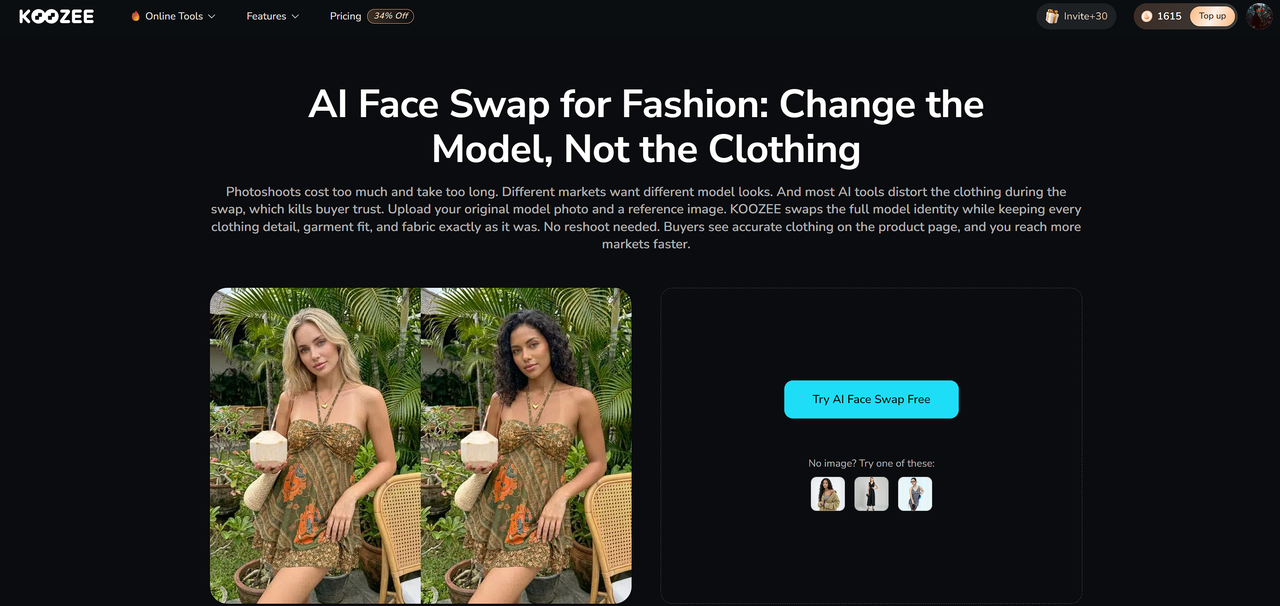
Unlike generic AI art tools, Koozee is built explicitly around the commercial operational workflows of apparel e-commerce. It acts as a dedicated visual layer that connects directly with your store, turning a single product photo into an entire season’s worth of marketing assets.
Here's what that means in practice:
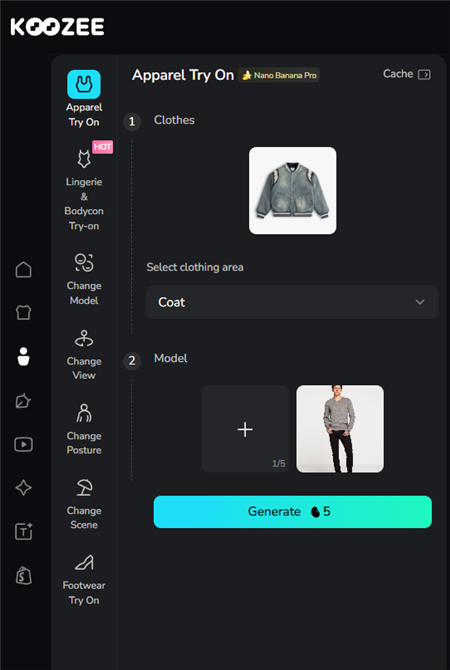
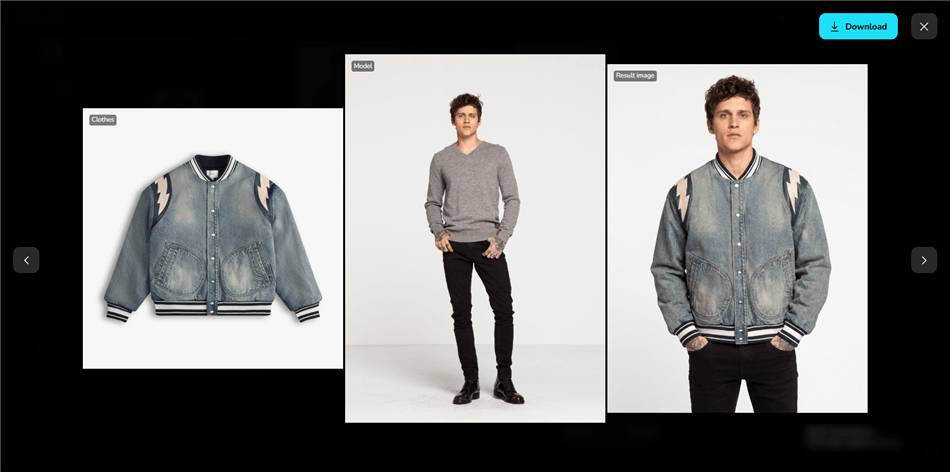
AI Apparel Try-On: Upload a clothing product image and generate on-model visuals without arranging a photoshoot. Change the model, change the scene, change the pose — all from a single product image.
Lingerie, Swimwear & Bodycon Try-On: For high-cost apparel categories where traditional photoshoots are especially expensive and model sourcing is especially difficult, Koozee provides a dedicated try-on workflow that keeps the focus on product presentation for e-commerce.
Apparel Videos & Dynamic Lookbooks: Turn static clothing images into product videos, dynamic lookbooks, fit check videos, and short outfit clips for Shopify, Amazon, TikTok, and Instagram — without a video production team.
Shopify-Connected Product Workspace: Connect your Shopify store, select a product, generate listing-ready apparel visuals, preview the results, and manually publish approved assets back to Shopify. No downloading, renaming, or re-uploading required.
Product Listing Page Visuals & Campaign Assets: Create structured product page visuals, promotional posters, and campaign creatives from your existing product images.
The Koozee Production Workflow:
Step 1. Connect & Sync: Connect your Shopify store to access your unified, product-level image workspace without the tedious friction of downloading, local renaming, and re-uploading.
Step 2. Reference & Generate: Upload your existing flat-lay or garment photo, then provide a reference image of your target model or aesthetic. Koozee instantly merges them to generate hyper-realistic, fashion-aware try-on visuals across customized body types, faces, scenes, and postures without the friction of traditional casting.
Step 3. Review & Publish: Preview the final generated results inside your workspace and manually publish approved assets directly back to your active store listings with total creative control.
Call to Action: Stop Letting Unpredictable Production Invoices Ruin Your Margins
You now have the full picture: the real cost tiers for photo shooting models, the hidden fees that inflate every invoice, and the budget strategies that high-volume apparel brands use to protect their margins.
The next step is yours.
Option 1: Use the pricing framework in this guide to build a realistic photoshoot budget before your next production day. Know your model tier, lock in your usage rights, and have a backup plan for every vendor.
Option 2: If you're ready to reduce your dependency on traditional photoshoots entirely, start generating AI apparel visuals with Koozee — free to try with your own product images.
Either way, you're now equipped to make smarter decisions about where your visual production budget goes — and where it doesn't.
Frequently Asked Questions
How much does it cost to do a photoshoot for a clothing brand?
A small-scale, half-day photoshoot covering one model, a photographer, and a basic studio rental typically runs $1,200 to $3,500. A full-scale commercial shoot with agency talent, a crew, hair and makeup, and equipment rental easily reaches $3,500 to $6,000 or more per day. Alternatively, apparel brands can bypass these upfront expenses entirely by uploading flat-lays to Koozee.ai to generate high-converting on-model assets instantly.
How much do models get paid per shoot?
Freelance models generally earn $300 to $800 for a half-day and $500 to $1,200 for a full day. Agency models command $800 to $1,500 or more per day, excluding the agency's booking fee. Influencer-models charge a premium that scales with their reach, with micro-influencers ranging from $500 to $1,500 and mid-tier creators commanding $3,000 to $8,000 or more for a combined shoot-and-social-post package.
Do I need a model release for e-commerce product photos?
Yes, a standard modeling fee only covers the model's time on set. To run Meta, TikTok, or Google Shopping ads legally without the risk of forced ad takedowns or platform penalties, you must have a signed Model Release that explicitly covers commercial digital use, duration, and geographic scope.
How can I reduce my apparel photoshoot costs?
Clothing brands can reduce costs by using the chin-crop method for product pages to eliminate hair and makeup fees, saving $200 to $600 per day. Another strategy is the tactical split, where you book a premium model for a tight 2-hour lifestyle window and swap to a lower-cost model for standard studio shots. Finally, brands can cut production costs by replacing traditional live sets with AI production workflows like Koozee to generate studio-quality apparel try-ons.
Can I use AI-generated model images instead of hiring real models?
Yes, for standard e-commerce workflows. While high-fashion branding still relies on live sets, AI tools built specifically for apparel—like Koozee—can generate flawless on-model try-ons, lifestyle scene swaps, and product videos directly from your existing clothing photos, drastically cutting your per-SKU visual costs.
What's the difference between a fitting model and a commercial model?
A fitting model is hired strictly for their body measurements to check garment drape and sample sizing, costing around $40 to $75 per hour with images typically cropped or used internally. A commercial model is hired for their face, look, and on-camera presence to drive customer-facing campaigns, ads, and product listings, commanding higher rates of $55 to $150 or more per hour.
What other costs should I budget for besides the model?
A standard production day requires budgeting for a photographer at $500 to $1,500, a studio rental at $400 to $800, and a hair and makeup artist at $200 to $600. When you add gear rentals, styling, and post-production retouching, your non-model overhead totals $1,500 to $4,000 per day, which represents sunk capital if your hired model flakes at the last minute.
You May Be Interested

9 Best AI Fashion Model Generators for E-commerce (2026)

6 Best Plus Size AI Model Generators for Apparel Sellers
Flat Lay to Model AI: Turn Flat Lay Clothing Photos into On-Model Images
