How E-commerce Image Localization Boosts Conversions [For Apparel Sellers]
Learn how e-commerce product image localization helps apparel sellers boost conversions across markets. Explore AI model replacement, cultural adaptation, and the impact of localized images on conversion rates.


If you're running cross-border e-commerce (especially in apparel), this might sound familiar:
You’ve translated your product pages
You’ve localized pricing and currency
You’ve launched into new markets
…yet your conversion rate is still low — especially in those new regions. So what’s going wrong? It’s probably not your copy. It’s your images.
Showing the same models, backgrounds, and visual style to customers in Tokyo, Berlin, and São Paulo creates a subtle but powerful disconnect — even when everything is perfectly translated.
That’s where e-commerce image localization comes in. Done right, it helps customers see themselves in your product — and that’s what drives them to buy.
Key Takeaways
Image localization drives revenue: Localized visuals can significantly improve conversion rates and customer engagement.
AI model change is the fastest path: Koozee helps apparel sellers generate localized model variations from existing product images, including changes to the model’s appearance, pose, and scene — without arranging a separate photoshoot for every market.
Localization goes beyond language: Models, colors, and styling all carry cultural meaning — and mismatches hurt trust.
Apparel benefits the most: Fashion is highly visual and culturally sensitive, making image localization especially impactful.
Start small: Test one product in one market, measure results, then scale.
Why E-commerce Image Localization Matters for Apparel Sellers
Most brands localize language first — product copy, sizing, shipping. That’s necessary, but not enough.
Shoppers judge your product in milliseconds — and mostly through visuals. If your model and setting feel foreign, trust drops instantly, even if the product fits their needs.
E-commerce image localization fixes this by adapting visuals to each market. This includes:
Using locally relevant models
Matching familiar environments
Aligning colors and styling with local taste
Translating text within images
Reflecting seasonal context
For apparel, this matters more than almost any category. Clothing is worn in specific cultural and seasonal contexts — and when visuals don’t match, conversion suffers.
How Localized Product Images Affect E-commerce Performance
The business case for image localization is clear: better visual relevance leads to better performance.
Conversion rates
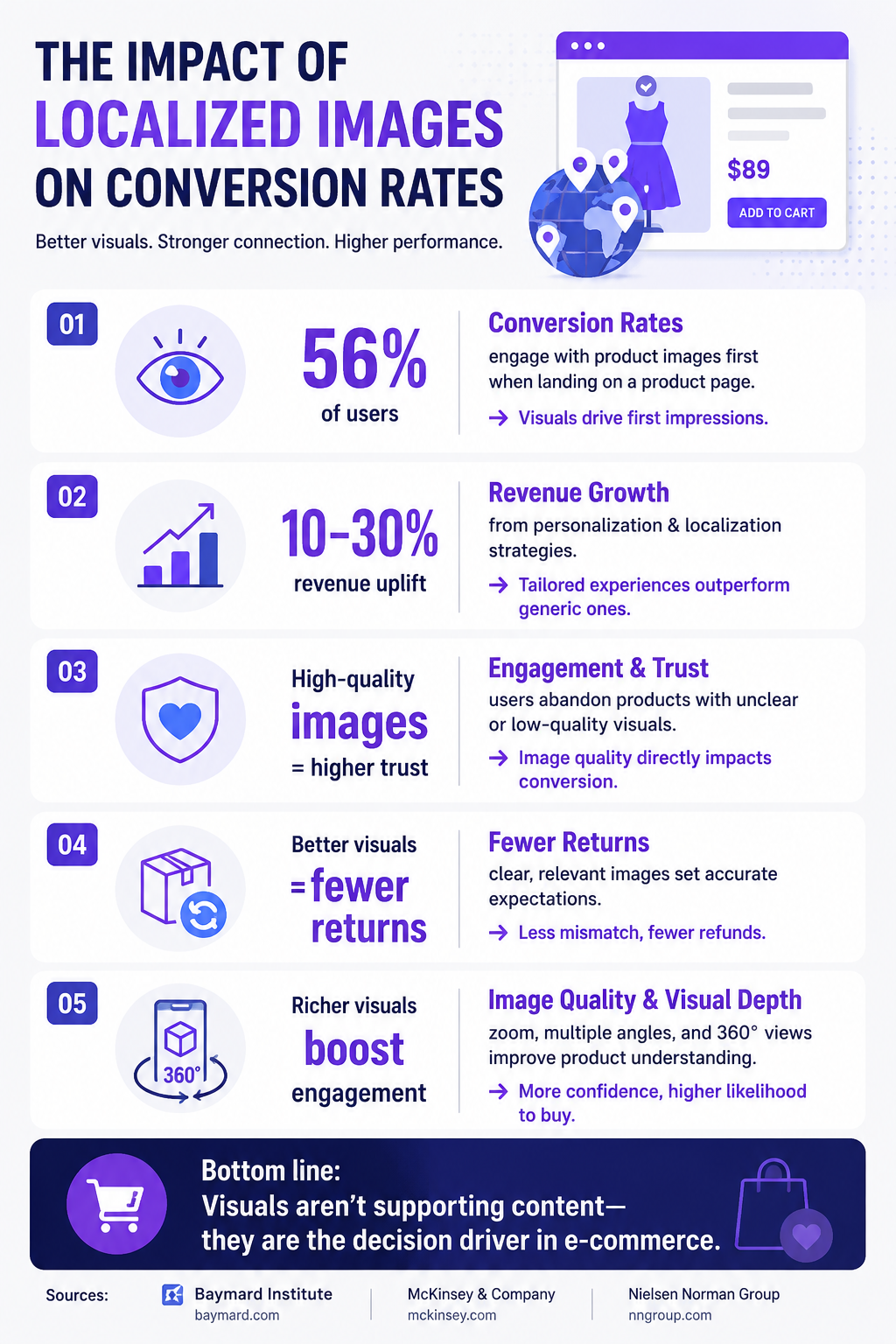
Localized content has a proven impact on user behavior. Research shows that users rely heavily on visuals when making purchase decisions — in fact, 56% of users immediately engage with product images when landing on a product page.
Revenue growth
Personalization and localization strategies — including adapting content and visuals to local audiences — have been shown to improve business performance significantly. Leading companies consistently outperform peers when they tailor experiences to customer preferences.
Engagement and trust
According to Baymard's study on image quality impact, visual quality and relevance directly influence trust. Low-quality or unclear images often lead users to abandon a product entirely, while high-quality visuals increase confidence in purchase decisions.
Fewer returns
Clear, detailed, and contextually relevant product images help users better understand what they are buying. When expectations are aligned with reality, the likelihood of dissatisfaction — and returns — decreases.
Image quality and visual depth
Providing richer visual information improves product understanding. Research shows that users respond positively to detailed product imagery, including zoom functionality and multiple viewing angles, while more immersive formats like video and 360° views enhance product perception by giving users a better “feel” for the item.
In e-commerce, visuals are not just supportive content — they are central to how users evaluate products, build trust, and ultimately decide to buy.
How to Make E-Commerce Image Localization - 4 Methods
Method 1: AI Model Change — Localize Apparel Images with Koozee
The most powerful form of e-commerce image localization for apparel sellers is replacing the model entirely — not just translating text or swapping backgrounds, but showing your clothing on models who match the demographics and style preferences of each target market.
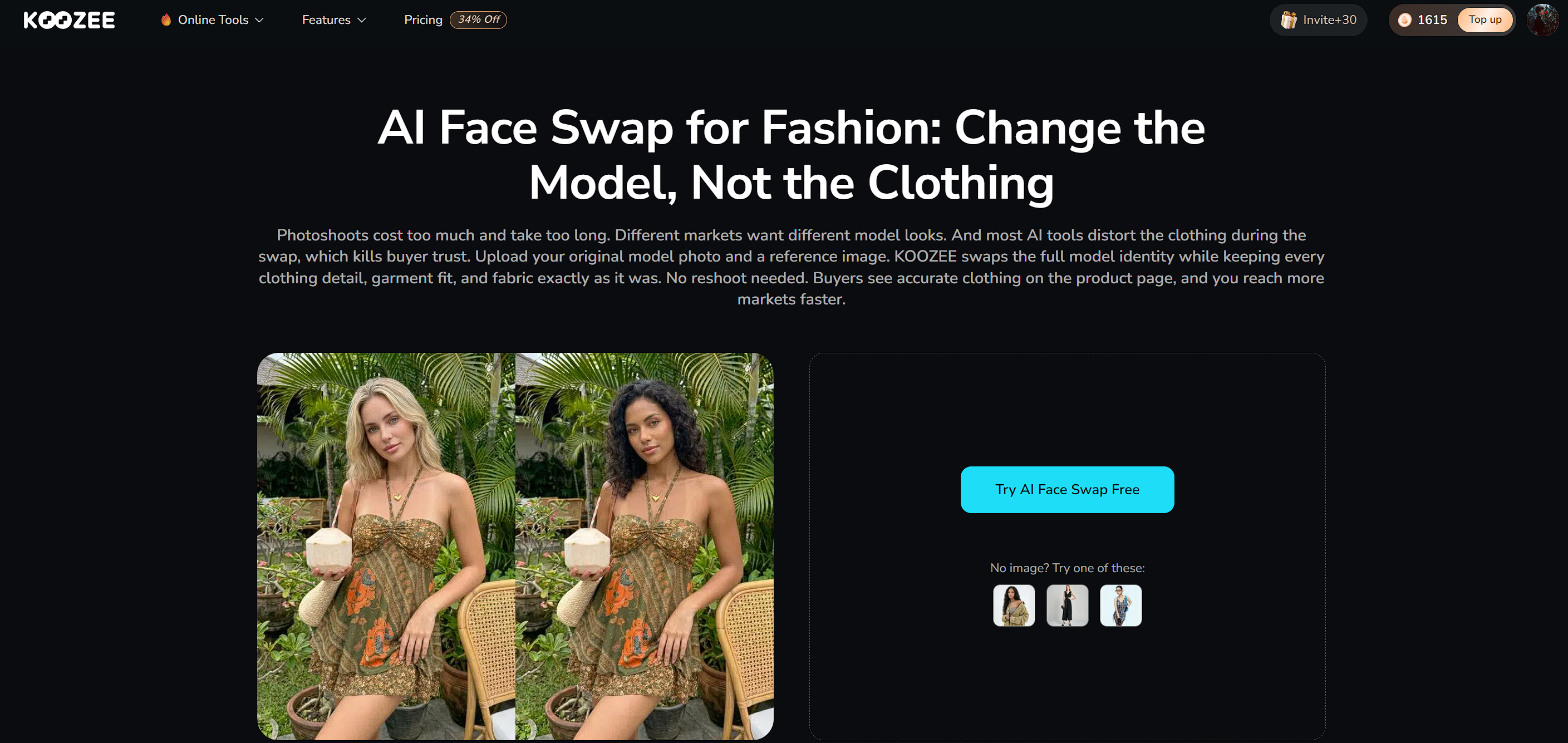
Koozee's AI Model Change feature is built specifically for this workflow. It takes your existing model photo and a reference image of your target model, then generates a new image where the garment is worn by the new model — with face, body type, skin tone, and overall presence fully replaced, while the clothing's fabric texture, color, silhouette, and fit remain intact.
This is fundamentally different from face-swap tools that only replace the face while leaving the original body unchanged.
Key Features of Koozee AI Model Change
No Pre-built Library Needed: Use authorized reference images, such as licensed model photos, approved brand ambassador images, or internally approved creative references. No extensive model training is required.
Preserved Garment Details: The AI is optimized for clothing, keeping the fabric texture, silhouette, and color accuracy intact while adapting to the new body shape.
Support for Niche Categories: Unlike general-purpose AI generators that often over-block intimate fashion, Koozee natively supports lingerie, swimwear, and bodycon categories—the very areas where model localization has the highest ROI.
Visual Consistency: Because all localized variations are generated from your single original photo, the studio lighting, composition, and background remain completely unified across your global catalog.
How to Localize Apparel Images with Koozee — 3 Steps
Step 1: Open the AI Model Change tool
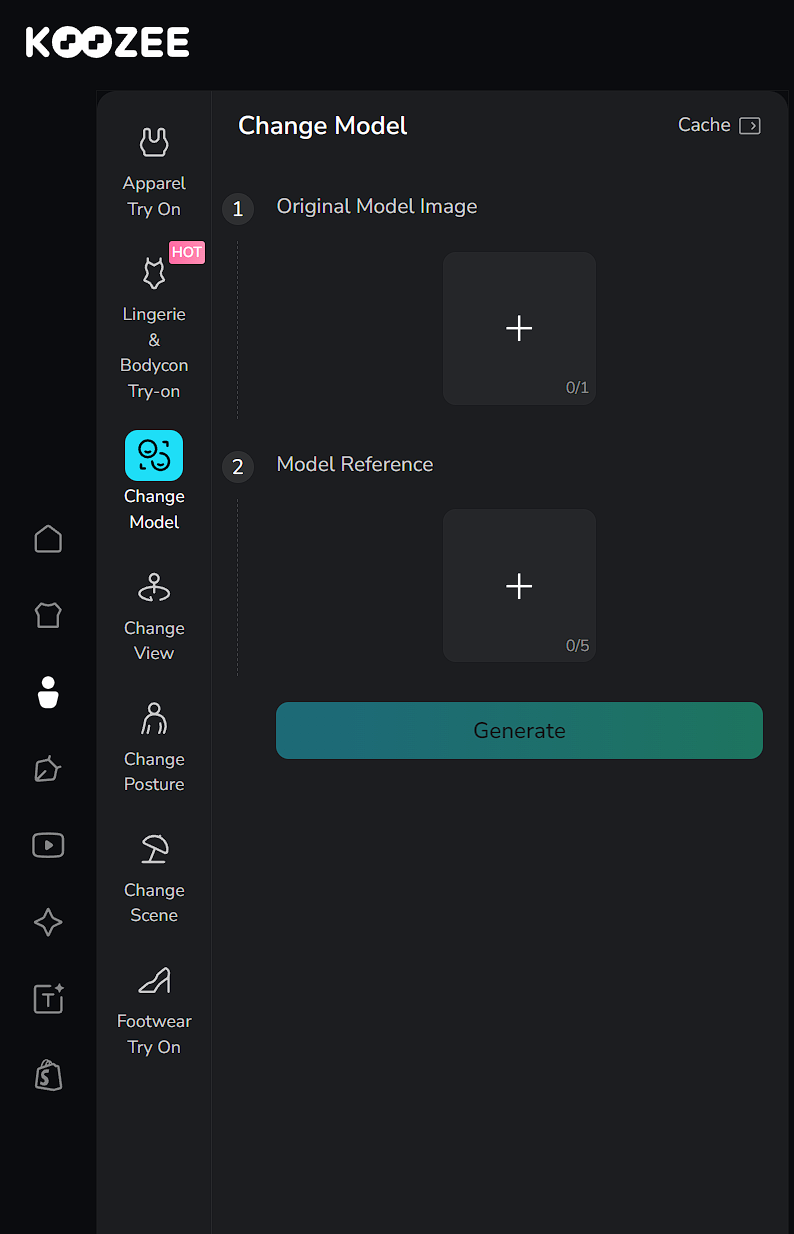
Inside the Koozee workspace, select the AI Model Change function. It's one of the core tools in the platform, built into the same workflow as other apparel production features like try-on, scene change, and video generation.
Step 2: Upload your original model photo
Upload the product image you want to localize — the original model shot showing your garment. This is the base image. Koozee works with standard product photography; no special formatting is required.
Step 3: Upload your target model reference image
Upload 1 to 5 reference images of the model you want to appear in the localized version. This can be any person — a model who matches your target market's demographics, a brand ambassador for that region, or simply an image that represents the look your local audience responds to. Koozee automatically replaces the original model with the new one, preserving all garment details.
💡 Pro tip: Start with your top 3–5 products in one new market. Upload reference images that reflect the specific demographic you're targeting (age range, style, body type), generate localized versions, and track the conversion difference against your original images. Let the data guide which products to localize next.
📌 Note: As with any AI-generated visual, review the output before publishing. While Koozee is optimized for apparel accuracy, having someone familiar with the target market check for cultural appropriateness is always a smart step — especially for markets with distinct fashion norms or modesty expectations.
Method 2: Scene and Background Localization — Put Products in Local Contexts
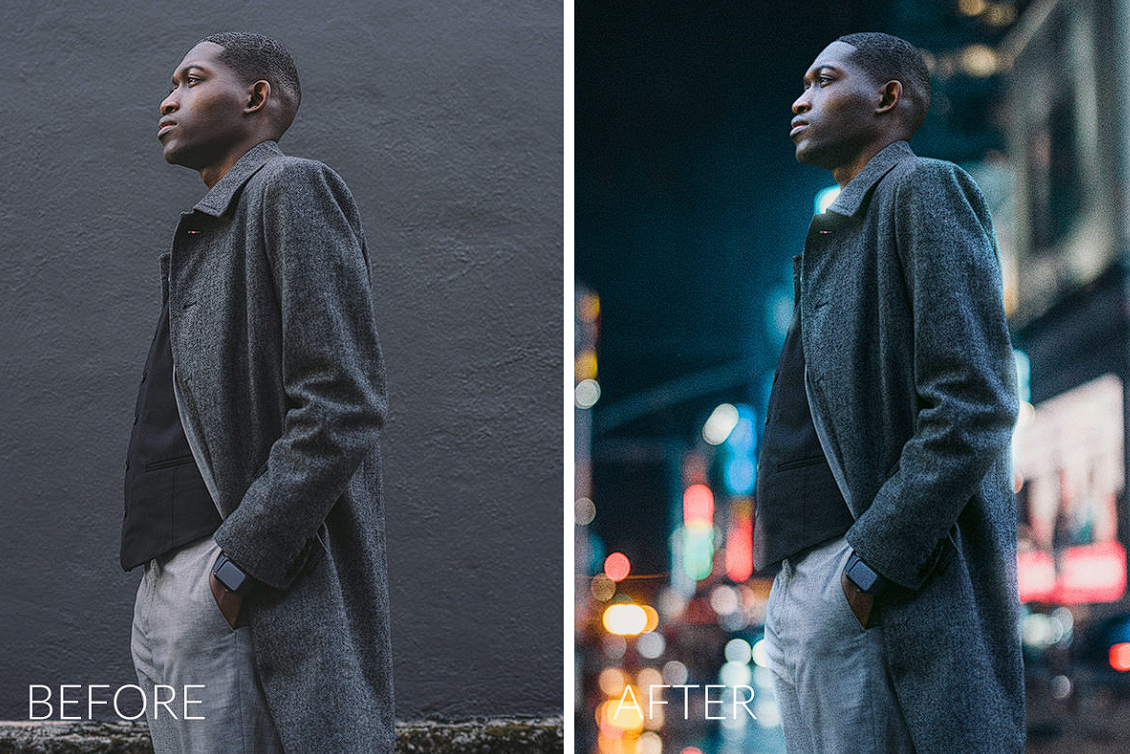
Sometimes the model isn't the issue — the setting is. A product shot against a generic white background may work for your primary market, but adding localized scenes can significantly increase relevance and engagement in new regions.
What scene localization looks like in practice:
A winter coat photographed in a snowy street scene for Nordic markets, a city street for Northern Europe, and an indoor setting for warmer regions where it's a travel purchase
Activewear shown in parks that look like the parks your target customers actually visit — not an anonymous green field
Home and lifestyle products placed in interiors that reflect local architecture and living spaces
How to implement scene localization:
Identify high-impact products — not every SKU needs a localized scene; start with hero products and bestsellers
Research local visual context — what do real homes, streets, and lifestyles look like in the target market? Look at local competitors' product photography for reference
Use AI background replacement tools — many AI image platforms can swap backgrounds while keeping the product and model intact
Test relevance — show localized and non-localized versions to local audiences and measure engagement
💡 Pro tip: For markets where you're testing the waters, use AI-generated backgrounds first. If conversion data shows a meaningful lift, invest in locally photographed lifestyle imagery for your top-selling products.
Scene localization pairs especially well with model localization. When both the person wearing the garment and the environment around them feel familiar, the product image tells a complete story that resonates with the local shopper.
Method 3: Cultural Adaptation of Colors, Symbols, and Visual Style
Beyond models and backgrounds, cultural adaptation touches the subtler layers of visual communication: color meanings, symbolism, gestures, and aesthetic preferences.
These elements are easy to overlook but can make or break a localized product page:
Color symbolism varies by market:
White represents purity and weddings in Western markets, but mourning in parts of East Asia
Red signals luck and prosperity in China, danger or debt in some Western financial contexts
Green has strong religious associations in some Middle Eastern markets
Purple is associated with royalty in Europe but mourning in Thailand and Brazil
Gestures and body language:
Hand gestures and body language can be interpreted differently across markets, use poses when a local reviewer confirms they feel appropriate
The "OK" hand sign reads differently in Brazil, Germany, and Japan
Even the direction a model faces can carry cultural weight
Styling and fashion norms:
Necklines, sleeve lengths, and fit preferences vary significantly across markets — even for the same garment category
Styling combinations that look natural in one market may look odd in another (e.g., layering norms, shoe pairings)
Seasonality: showing a summer dress in January works for Australian shoppers but feels off for North American ones
Practical approach:
Work with local reviewers — even one person familiar with the target culture can catch issues AI and automated tools miss
Study local competitors — how do established local brands style and photograph similar products?
Create a market-specific visual checklist — document color preferences, styling norms, and visual taboos for each of your key markets
Start conservative, then iterate — begin with safe, widely accepted visual choices, then test bolder local adaptations as you gather data
⚠️ Warning: Cultural missteps in product imagery can do more harm than no localization at all. Shoppers in many markets say they would stop buying from a brand that used culturally inappropriate imagery. When in doubt, get local input before publishing.
Method 4: In-Image Text Translation and Currency Localization
The most straightforward form of e-commerce image localization is also one of the most commonly overlooked: text within product images.
Many apparel product images include embedded text — sale badges, feature callouts, size indicators, fabric composition labels, promotional banners, and lifestyle taglines. If that text is in your home-market language, it creates immediate friction for international shoppers.
What to localize in your product images:
Promotional badges: "50% OFF" → local language equivalents
Feature callouts: "Breathable Cotton" → translated and localized
Size guides embedded in images: Convert to local sizing standards (US, EU, UK, JP, etc.)
Currency and pricing: Show prices in local currency when embedded in banners
Care and material labels: Translate to the local language
Tools and workflow:
Use AI image translation tools to automatically detect text in images and replace it with translated versions. Tools like PicTech.AI, Loxalize, and ImageTranslate specialize in this workflow.
For Shopify stores, apps like Weglot and Langify can handle text translation across your store, including some image text replacement.
For text-heavy product images (like infographics or A+ Content), consider creating per-market versions rather than dynamically translating — the layout and design often need local adjustment too.
📌 Note: AI image text translation has improved significantly, but always have a native speaker review the output. Awkward translations in product images damage credibility more than untranslated text does.
Quick Comparison: E-Commerce Product Image Localization Methods
| Method | Best For | Cost Level | Speed | Technical Difficulty |
| AI Model Replacement | Apparel sellers entering multiple markets; lingerie, swimwear, fitted categories | Low–Medium | Hours | Low |
| Scene & Background Localization | Lifestyle products; brands where context matters (outdoor, home, fashion) | Low–Medium | Hours | Low |
| Cultural Adaptation | Brands in culturally sensitive categories; luxury and premium positioning | Medium | Days–Weeks | Medium–High |
| In-Image Text Translation | All cross-border sellers; highest volume, lowest effort impact | Low | Hours | Low |
How to Choose the Right E-Commerce Product Image Localization Approach
The right approach depends on your product category, target markets, and available resources. Here's a decision framework for apparel sellers:
Start with Method 4 (text translation) if you're just beginning cross-border expansion and want the fastest, lowest-cost win. Translated badges and banners alone can signal to shoppers that you've invested in their market.
Add Method 1 (AI model replacement) if you sell clothing, especially in categories where fit and appearance on a body drive purchase decisions, which is most apparel. This is where the impact of localized images on conversion rates is strongest. For lingerie, swimwear, and fitted categories, model localization is particularly high-impact because traditional photoshoots for these categories are disproportionately expensive.
Layer in Method 2 (scene localization) if your brand competes on lifestyle positioning rather than price. Outdoor, activewear, premium, and home-fashion brands benefit most from contextual settings.
Invest in Method 3 (cultural adaptation) if you're entering markets with significantly different cultural norms from your home market, or if your brand operates in luxury, modest fashion, or culturally specific categories.
✅ For most apparel sellers, the practical sequence is: text translation first → AI model replacement for top products in top markets → scene localization for hero products → cultural adaptation as a quality layer across all visuals.
FAQ: e-commerce Image Localization
What's the difference between image translation and image localization?
Image translation only changes the language of text within an image. Image localization adapts the entire visual — models, backgrounds, colors, styling, cultural references, and text — to match the target market's expectations. Translation is a subset of localization.
How much does e-commerce product image localization cost?
It depends on the method. AI-based methods are usually far less expensive than organizing separate photoshoots for each market, but the actual savings depend on the number of SKUs, markets, asset types, and your tool’s pricing or credit model. AI-based methods can reduce visual production costs by up to 85%.
Do I need to localize images for every market I sell in?
Not necessarily for every market, and not for every product. Prioritize: (1) markets with the highest revenue potential, (2) markets that are culturally most different from your home market, and (3) hero products that drive the majority of your sales. Start with 1–2 markets and 5–10 products, measure the impact, and expand from there.
How do I measure the impact of localized images on conversion rates?
The cleanest approach is to A/B test: show localized images to 50% of traffic in a target market and your standard images to the other 50%. Track conversion rate, average order value, and return rate for each group. If an A/B test isn't feasible, compare conversion rates before and after localization, controlling for seasonality and traffic sources.
Can I use AI to localize all my apparel product images?
AI can handle the bulk of the work — model replacement, background changes, text translation — but human review is essential. A local market expert should check for cultural accuracy, fabric representation, and brand consistency before publishing. Think of AI as your production engine and human review as your quality control.
Is image localization worth it for small apparel brands?
Yes — arguably more so than for large brands. Small apparel sellers often can't afford traditional multi-market photoshoots at all, so AI-based image localization opens up cross-border selling that was previously impossible. Even localizing images for just one additional market can open a meaningful new revenue channel. Start with one product, one market, and scale based on results.
Does image localization affect SEO?
Yes. When you localize images — including alt text, file names, and surrounding page content — you signal relevance to search engines in each target market. Image search, in particular, can drive significant traffic for apparel products, and localized images are more likely to rank for local-language visual searches.