12 Best Virtual Try-On Apps for E-Commerce Sellers, Brands, and Marketers
Read this post to get 12 best virtual try on apps by category. These apps turn flat product images into on-model visuals with realism.


Virtual try-on apps — whether AI-powered, AR-driven, or a mix of both — are proving to be one of the most effective ways to reduce returns, boost conversions, and keep shoppers on your product pages longer.
In this guide, we've sorted through dozens of virtual try-on tools to bring you 12 that actually deliver, for e-commerce sellers, brands, and marketing teams. These apps turn flat product images into on-model visuals with realism, include a wide variety of apparel categories, and you can integrate directly with popular e-commerce platforms.
Key Takeaways
Top pick for apparel sellers: KOOZEE is the best AI visual production platform for clothing e-commerce, combining try-on, model changes, video generation, and listing assets in one workflow.
Best all-around for beauty: YouCam Makeup by Perfect Corp leads with hyper-realistic AR try-on across makeup, hair, eyewear, and jewelry — with over 1 billion app downloads.
Best for eyewear retailers: Fittingbox offers the largest digitized frame library (195,000+ frames from 1,200+ brands) with accurate pupillary distance measurement and 3D rendering.
Best free consumer option: Google Shopping's Try On feature lets shoppers try shirts, pants, skirts, and dresses directly from search results — no app download needed.
What to look for: The right virtual try-on tool depends on your product category, whether you need B2B content generation or B2C shopping experiences, and how realistic the rendering needs to be for your specific use case.
Why Virtual Try-On Apps Matter for E-Commerce
Online clothing retail has a fundamental problem: customers can't touch, feel, or try on the product. Virtual try on tools address these issues by generating realistic on-model visuals from product images. For marketing teams, these tools:
Lower return rates: Brands using AI try-on report return reductions of 10% to 25%, directly improving margins.
Higher conversion rates: Product pages with try-on functionality see conversions lift by up to 94% on social commerce channels.
Faster visual production: Generate model visuals in minutes instead of weeks — no photographer, studio, or model coordination required.
Better ad creative: A/B test different models, scenes, and poses for paid campaigns without reshooting.
Market localization: Swap models, backgrounds, and styles to match regional audiences from one set of product images.
The virtual try-on market was valued at roughly $7.25 billion in 2025 and is projected to grow at over 15% annually through 2033. The message is clear: if you're not exploring virtual try-on for your e-commerce business in 2026, your competitors already are.
Quick Comparison Table of Reviewed Virtual Try On Apps
App | Best For | Category | Pricing | Platform |
KOOZEE | Apparel sellers (full visual workflow) | Clothing & Fashion | Credit-based (30 free credits) | Web |
Claid | On-model product image generation | Clothing & Fashion | From $9/mo | Web, Shopify API |
Google Shopping Try On | Free consumer clothing try-on | Clothing & Fashion | Free | Web (Google Search) |
Genlook | Shopify-native virtual try-on | Clothing & Fashion | Free (10 try-ons/mo); from $19/mo | Shopify |
Botika | Quick AI model iterations | Clothing & Fashion | Plans from approximately $18/month (billed annually) | Web, Shopify |
Fittingbox | Eyewear retailers | Glasses & Eyewear | Shopify plans start at around $40 to $99 per month | Web, Shopify, In-store |
Warby Parker App | DTC eyewear shopping | Glasses & Eyewear | Free | iOS, Android |
Zenni Optical | Budget-friendly glasses try-on | Glasses & Eyewear | Free | Web, iOS, Android |
GlamAR | Jewelry & accessories AR try-on | Watches & Jewelry | Custom (API-based) | Web, App SDK |
YouCam Makeup | Beauty brands & consumers | Makeup & Beauty | Freemium / Shopify from $379/mo | iOS, Android, Web |
Sephora Virtual Artist | Multi-brand beauty discovery | Makeup & Beauty | Free (in Sephora app) | iOS, Android, In-store |
L'Oréal ModiFace | Enterprise beauty brands | Makeup & Beauty | Custom (enterprise) | Web, App SDK |
Best Virtual Try-On Apps for Clothing & Fashion
The tools below represent the best attempts to bridge the gap between "looks okay on screen" and "looks right in person" — some focused on seller-side content generation, others on consumer-facing shopping experiences.
1. KOOZEE — Best AI Visual Production Platform for Apparel Sellers [B2B]
KOOZEE takes a different approach than most virtual try-on tools on this list: instead of being just a try-on feature, it's a full AI visual production workflow built specifically for apparel e-commerce. It allows you to turn flat product photos into on-model try-on visuals, lingerie and bodycon try-on images, product videos, dynamic lookbooks, fit check videos, product listing page assets, and campaign posters — all from one platform.
What makes KOOZEE especially valuable is how it handles categories that are traditionally expensive to shoot. Lingerie, swimwear, and bodycon apparel require specialized models and controlled environments — KOOZEE generates realistic try-on visuals for these categories while keeping the focus on product presentation. The platform also includes image enhancement, background removal, and watermark removal tools, making it a practical daily utility for apparel sellers who need more than just try-on.
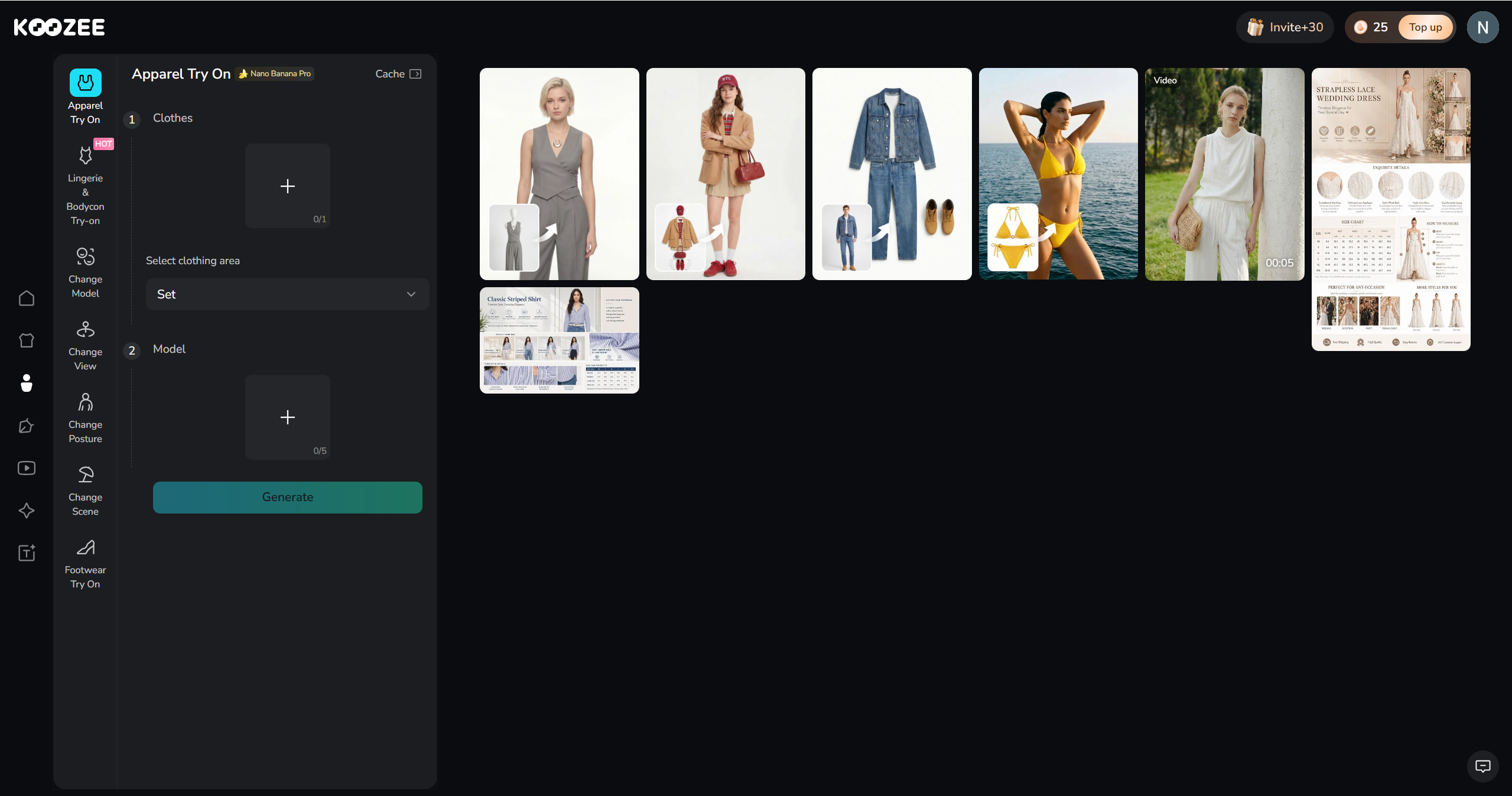
Key features:
AI apparel try-on from product images (clothing, lingerie, swimwear, bodycon)
Model, scene, pose, and angle changes from a single product photo
Apparel video generation: dynamic lookbooks, fit check videos (Fitlog), short outfit clips (Outfits)
Product listing page and campaign poster generation
Image enhancement, cutout, background removal, and watermark removal
Pricing: Credit-based — new users get 30 free credits to test, and credit packs include $14.9/300 credit, $50/1500 credit, and more. Paid plans available — start from $22.9/mo.
Best for: Shopify and marketplace apparel sellers, clothing brand founders, lingerie and swimwear sellers, and apparel wholesalers who need a complete visual production workflow beyond basic try-on.
Limitations: Credit-based pricing means costs scale with usage — heavy users need to monitor consumption. Output quality depends on input image quality. As with any AI try-on tool, results should be reviewed before publishing.
2. Claid — Best AI On-Model Product Image Generation for E-Commerce [B2B]
Claid focuses on turning flat product photos (flat-lay, hanger, or mannequin shots) into realistic on-model images. You upload a clothing photo, choose from a library of AI-generated fashion models (or upload your own for brand consistency), and Claid generates images with the garment rendered naturally on the model — preserving fabric textures, patterns, and even logos.
Beyond on-model generation, Claid offers AI Photoshoot for lifestyle scene creation, image enhancement tools (background removal, color correction, upscaling to 4K), and newer features like text-driven AI editing and image-to-video conversion. It integrates natively with Shopify and offers API access for automated workflows.
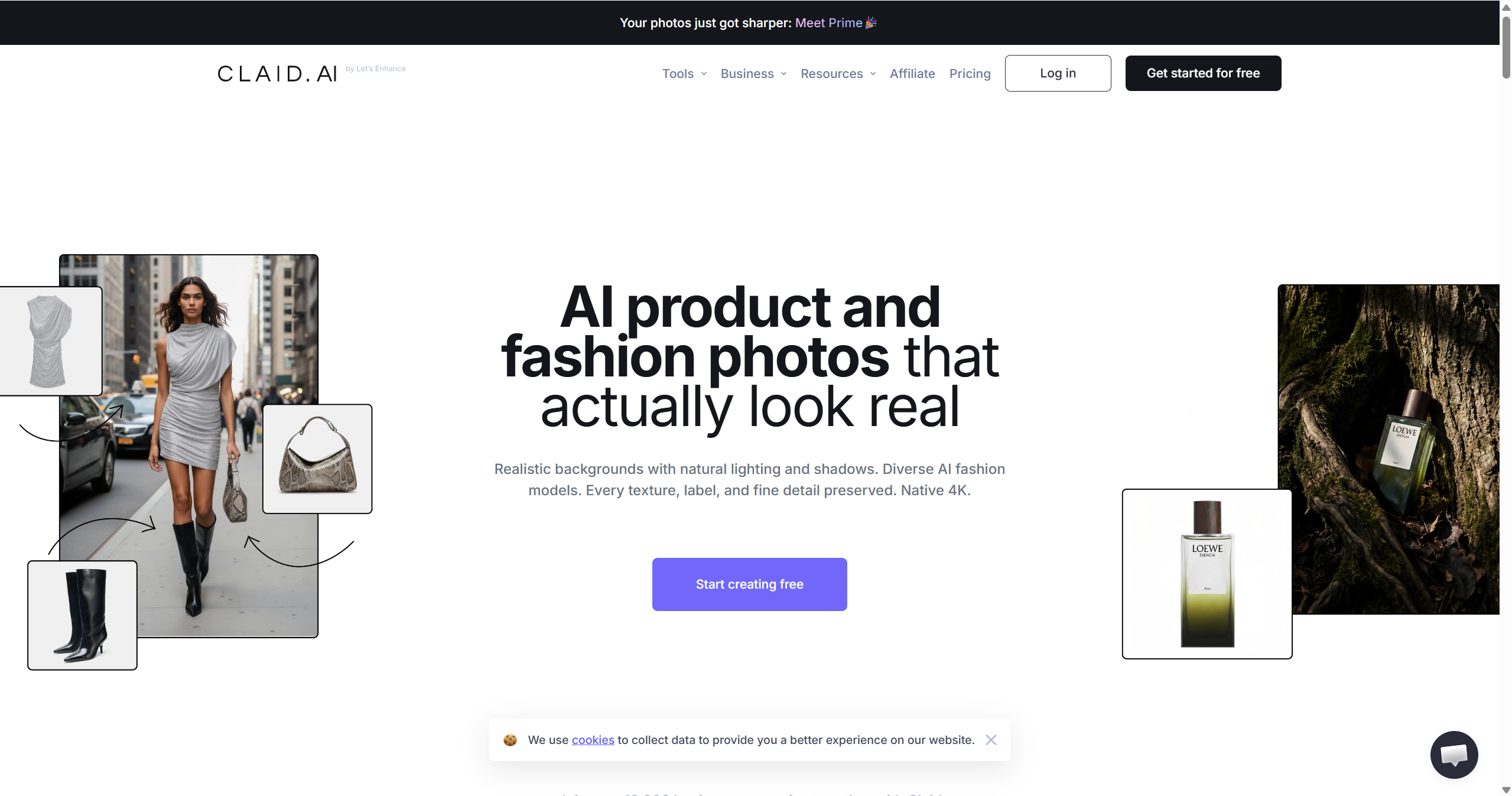
Key features:
On-model image generation from flat product photos
100+ virtual models, plus custom model upload
AI Photoshoot for lifestyle and seasonal scenes
Shopify integration and API for automated workflows
Image enhancement, background removal, upscaling to 4K
Pricing: Free plan (50 credits, 50 API credits). Paid plan from ~$9/mo (billed yearly).
Best for: E-commerce brands and Shopify sellers who need to generate consistent on-model product images at scale without booking photoshoots for every SKU.
Limitations: The consumer-facing virtual try-on experience (shoppers seeing themselves in products) is not Claid's focus — it's a content generation tool for sellers. Output quality varies by garment type; complex patterns and unusual cuts may need more manual adjustment. The free tier is very limited.
3. Google Shopping Try On — Best Free Consumer-Facing Clothing Virtual Try-On [B2C]
Google entered the virtual try-on space in a big way, and because it's built into Google Search results, the reach is enormous. Now it is available in several supported markets, including the United States, Canada, the United Kingdom, etc. Shoppers can upload a selfie and virtually try on shirts, pants, skirts, and dresses directly from product listings in Google Shopping.
The key advantage here is friction: no app download, no new account, no plugin — it's just there when you search for clothes. For brands whose products appear in Google Shopping, having VTO-ready listings is becoming a competitive differentiator.
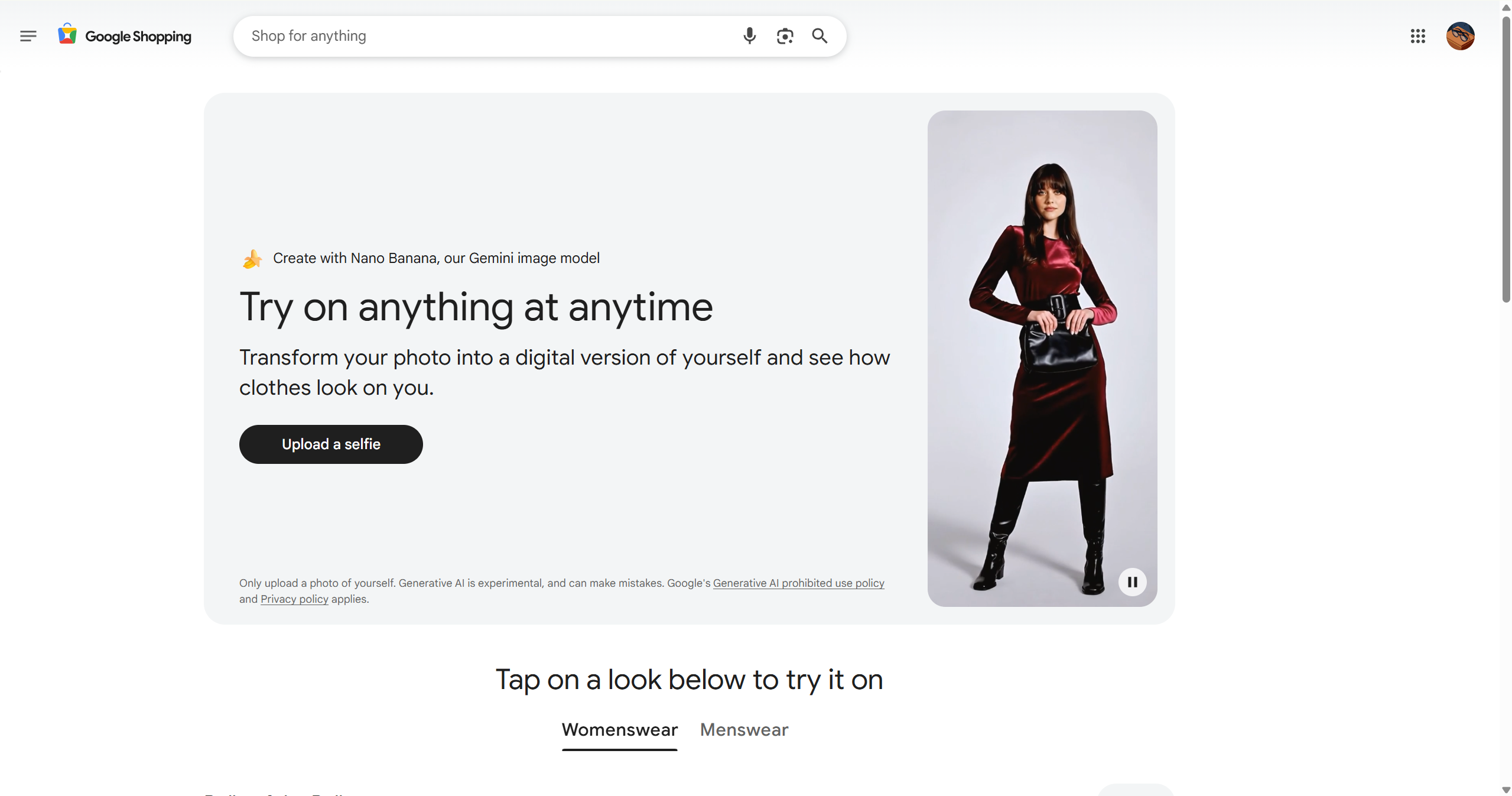
Key features:
AI clothing try-on directly in Google Search results
Supports shirts, pants, skirts, and dresses
Works from selfie to a single uploaded full-length photo
No app or account required
Pricing: Free for shoppers. For sellers, inclusion depends on Google Shopping product feed optimization.
Best for: Consumers who want instant, no-friction clothing try-on while browsing — and brands who want their products to stand out in Google Shopping results.
Limitations: U.S.-only as of early 2026. Limited to specific clothing categories. Sellers have no direct control over the VTO quality or presentation on Google's end. No B2B content generation features.
4. Genlook — Best Shopify-Native Virtual Try-On Plugin [B2B]
Genlook is built specifically for Shopify merchants who want to add a "Try It On" button to their product pages. Shoppers upload a photo, and Genlook renders the garment onto their body using generative AI. It primarily focuses on apparel virtual try-on for Shopify stores., making it one of the more versatile Shopify-native VTO apps.
The setup is minimal: install the app, configure your product catalog, and the try-on widget appears on your store. Genlook also offers an analytics dashboard to measure try-on-to-purchase conversion rates, and integrates with Klaviyo for email capture from try-on users.
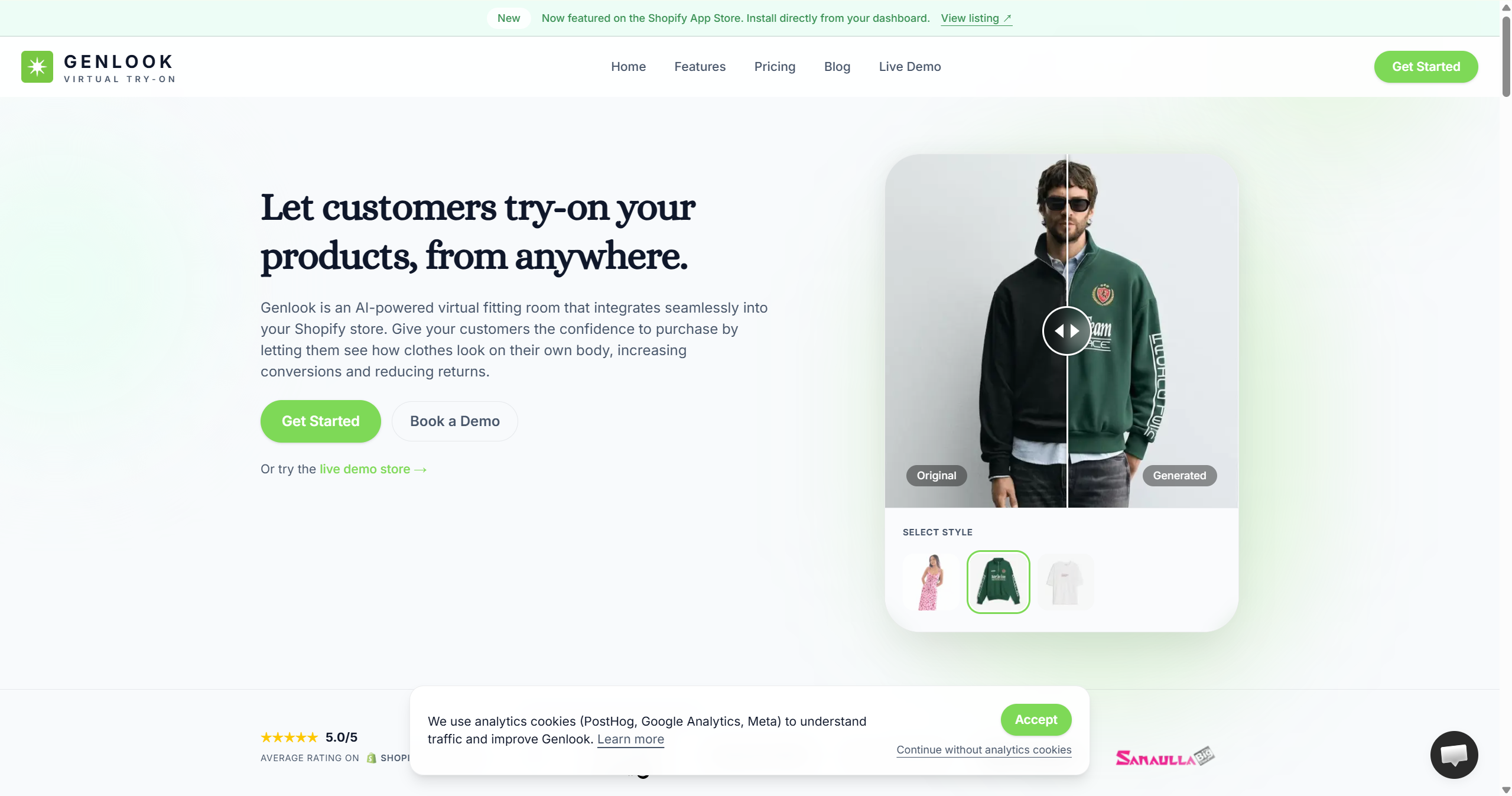
Key features:
"Try It On" button for Shopify product pages
Supports clothing, footwear, and eyewear
Analytics dashboard for VTO conversion tracking
Klaviyo integration for lead capture
Diverse AI model options
Pricing: Free plan (10 try-ons/month). Paid plans from $19/month to $99/month depending on try-on volume.
Best for: Shopify clothing sellers who want an easy, no-code virtual try-on widget with measurable ROI tracking.
Limitations: Smaller user base and shorter track record compared to enterprise alternatives. Try-on quality depends on the quality of shopper-uploaded photos, which can vary widely. The free tier is too limited for any serious store.
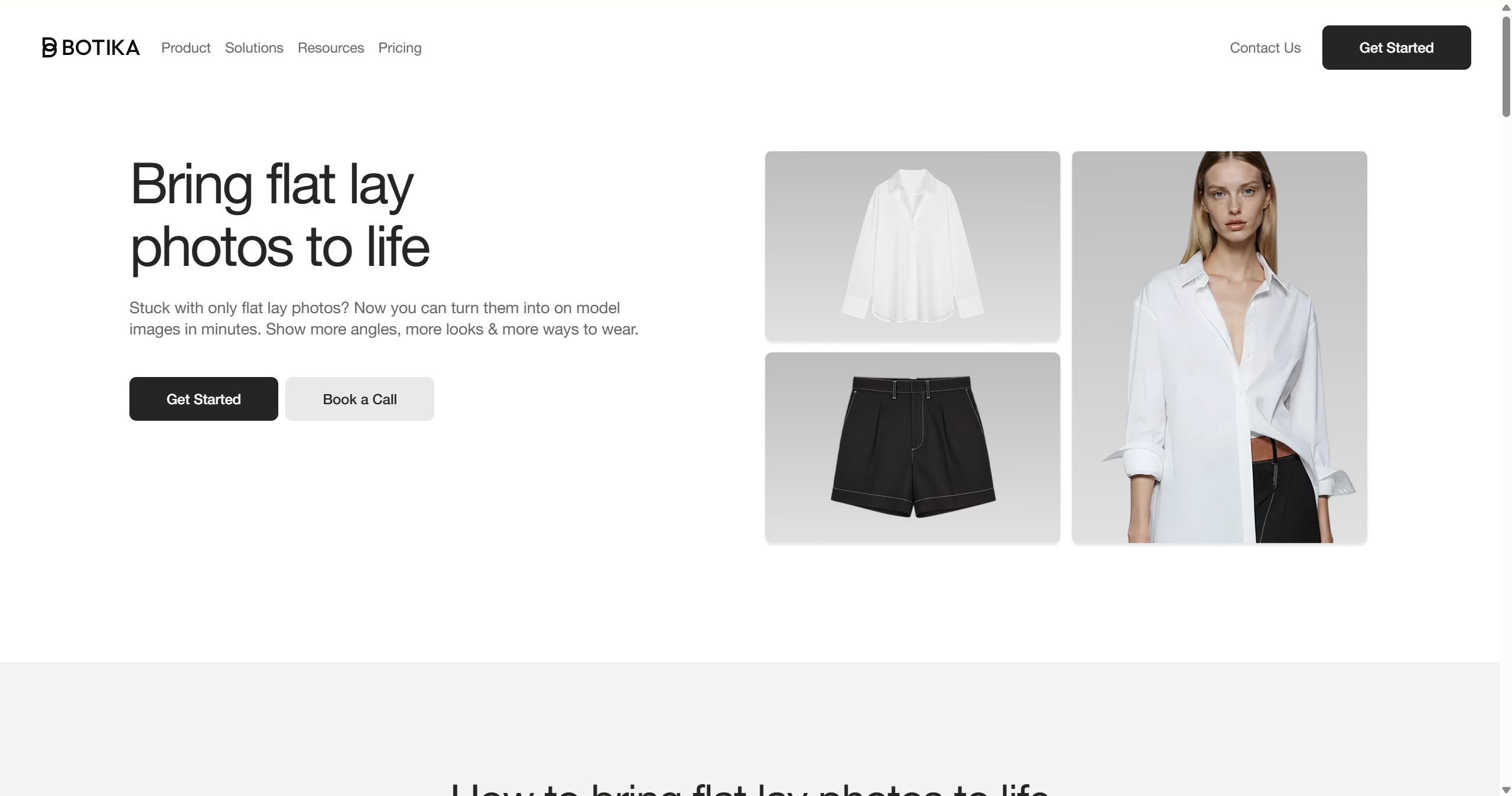
5. Botika — Best for Quick AI Model Iterations and Diversity [B2B]
Botika helps fashion brands generate on-model product images quickly, with a strong emphasis on model diversity. You can swap models across different ages, skin tones, body types, and styles without reshooting — all from a single product photo. This is particularly useful for brands selling across multiple markets who want localized, representative imagery without running separate photoshoots for each region.
Botika's AI generates images fast (often under a minute), and the interface is designed for volume: upload a batch of products, choose your models and scenes, and generate dozens of variations in one session.
Key features:
Fast AI on-model image generation from product photos
Diverse model selection: age, skin tone, body type, style
Batch generation for high-volume catalogs
Shopify integration available
Pricing: Plans from approximately $18/month (billed annually) to custom enterprise pricing.
Best for: Fashion brands and multi-market apparel sellers who need diverse, localized model imagery at speed and scale.
Limitations: Focused on seller-side image generation rather than shopper-facing try-on. Output consistency across large batches can vary. The entry-level plan has limited generation credits.
Best Virtual Try-On Apps for Glasses & Eyewear
Eyewear virtual try-on has quietly become one of the most reliable VTO categories. Below are accurate and higher-rated ones for trying on eyewear and glasses.
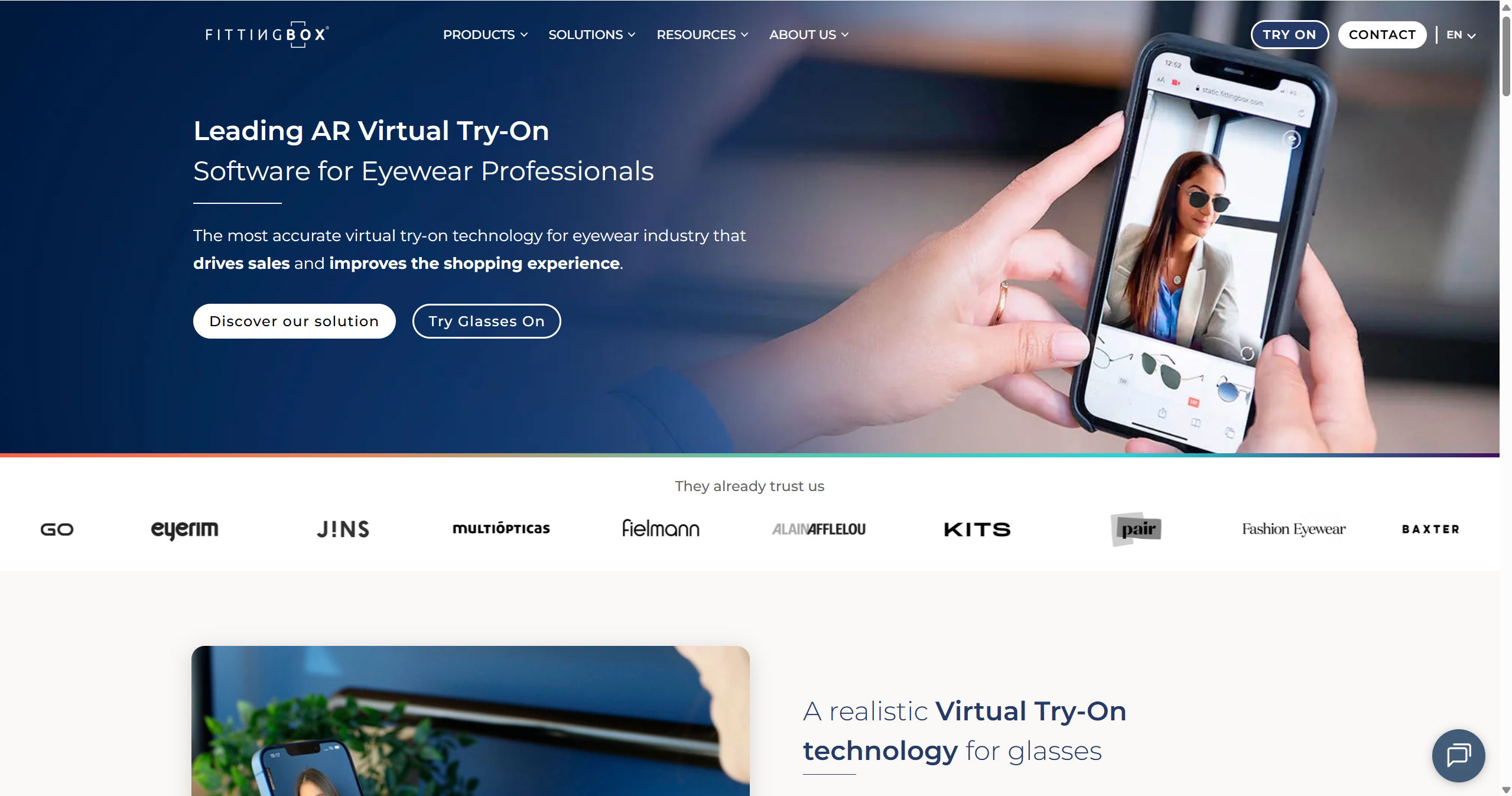
6. Fittingbox — Best Virtual Try-On Platform for Eyewear Retailers [B2B]
Fittingbox is the industry standard for eyewear virtual try-on. With over 195,000 digitized 3D frames from more than 1,200 brands — the largest database in the world — it powers VTO experiences for Specsavers, Zenni, Alensa, and over 4,000 other clients globally, generating 215 million virtual try-ons per year.
What sets Fittingbox apart is the realism of its 3D rendering. Frames are displayed at accurate size on the user's face, lens tints and coatings are simulated, and it even offers "Frame Removal" that digitally erases the glasses a user is already wearing for a clean try-on. The PD measurement tool, Face Shape API for frame recommendations, and lens simulator for photochromic and tinted options make it a complete eyewear shopping toolkit.
Key features:
195,000+ 3D frames from 1,200+ brands
Automatic PD (pupillary distance) measurement
Lens tint, coating, and photochromic simulation
Frame Removal technology for try-on over existing glasses
Shopify app with tiered pricing
Pricing: Shopify plans start at around $40 to $99 per month.
Rating: 4.7 out 5 on Shopify App Store with 12 ratings.
Best for: Eyewear retailers of any size — from a single optical shop to global chains — who need the most realistic, feature-rich VTO available.
Limitations: Frame digitization costs can add up for retailers with large, non-standard catalogs. The Shopify app's entry-level plan limits active products and users quite tightly.
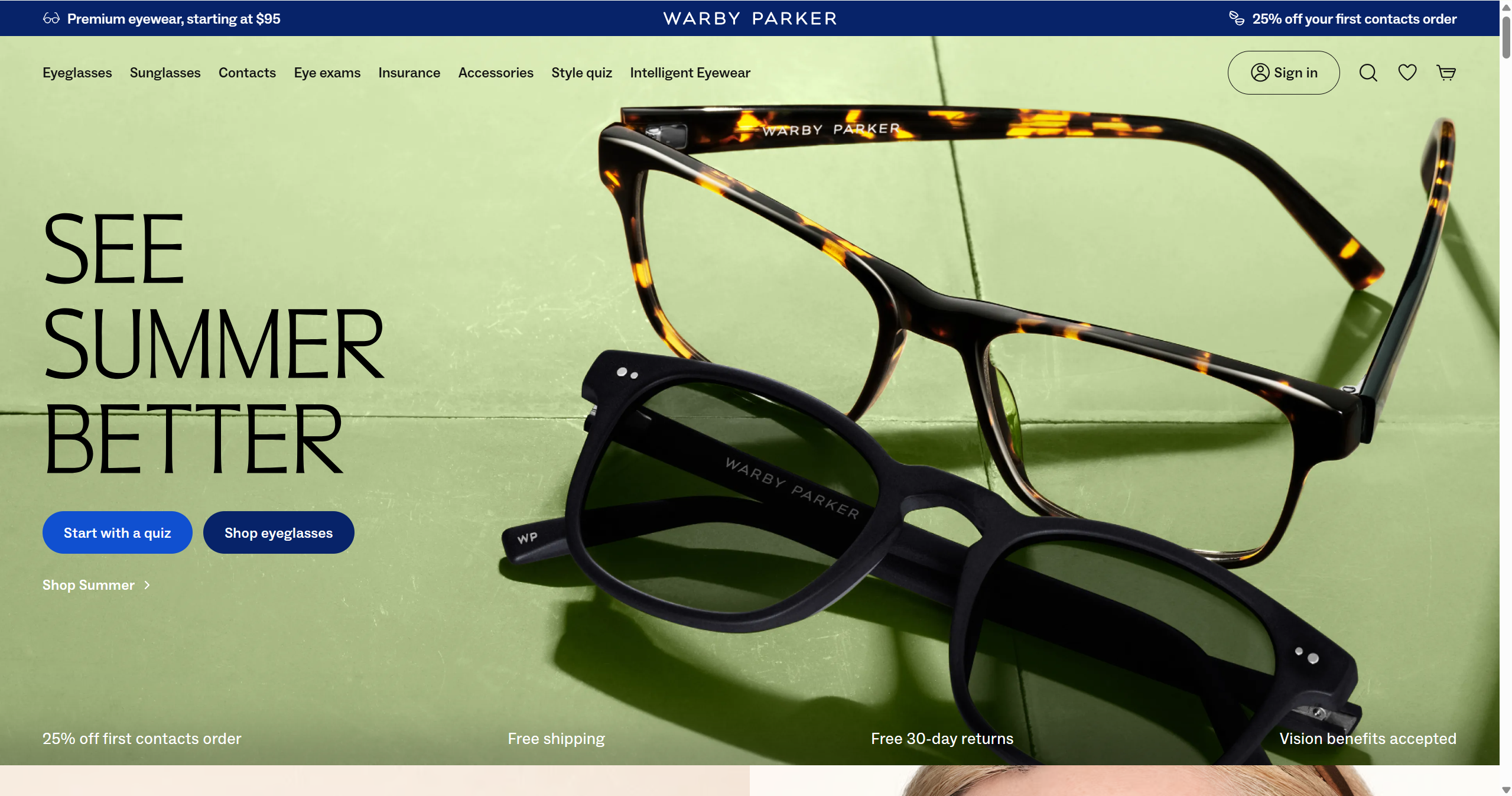
7. Warby Parker — Best Direct-to-Consumer Eyewear Virtual Try-On [B2C]
Warby Parker helped popularize the direct-to-consumer eyewear model, and their app's virtual try-on is a core part of it. The experience is straightforward: the app uses your phone's front camera to map your face, then overlays frames in real time. You can try on any frame in the Warby Parker catalog, save favorites, and order a Home Try-On kit with your top 5 picks — combining digital and physical try-on in a way that converts remarkably well.
The technology isn't the most technically advanced, but the UX is polished and it's deeply integrated into Warby Parker's purchase flow, which is what matters.
Key features:
Real-time AR frame try-on using front camera
Apple Face ID-depth sensor for more accurate scaling (iPhone)
Save favorites and order Home Try-On kits
Prescription upload and virtual consultation options
Pricing: Free (Most prescription glasses include lenses, with pricing varying by frame selection).
Rating: 4.9 out of 5 on App Store with 295436 ratings.
Best for: Consumers shopping for prescription glasses or sunglasses who want the most seamless try-on-to-purchase flow.
Limitations: Only works for Warby Parker frames. No B2B option. The app focuses on virtual frame visualization rather than advanced optical measurement tools.
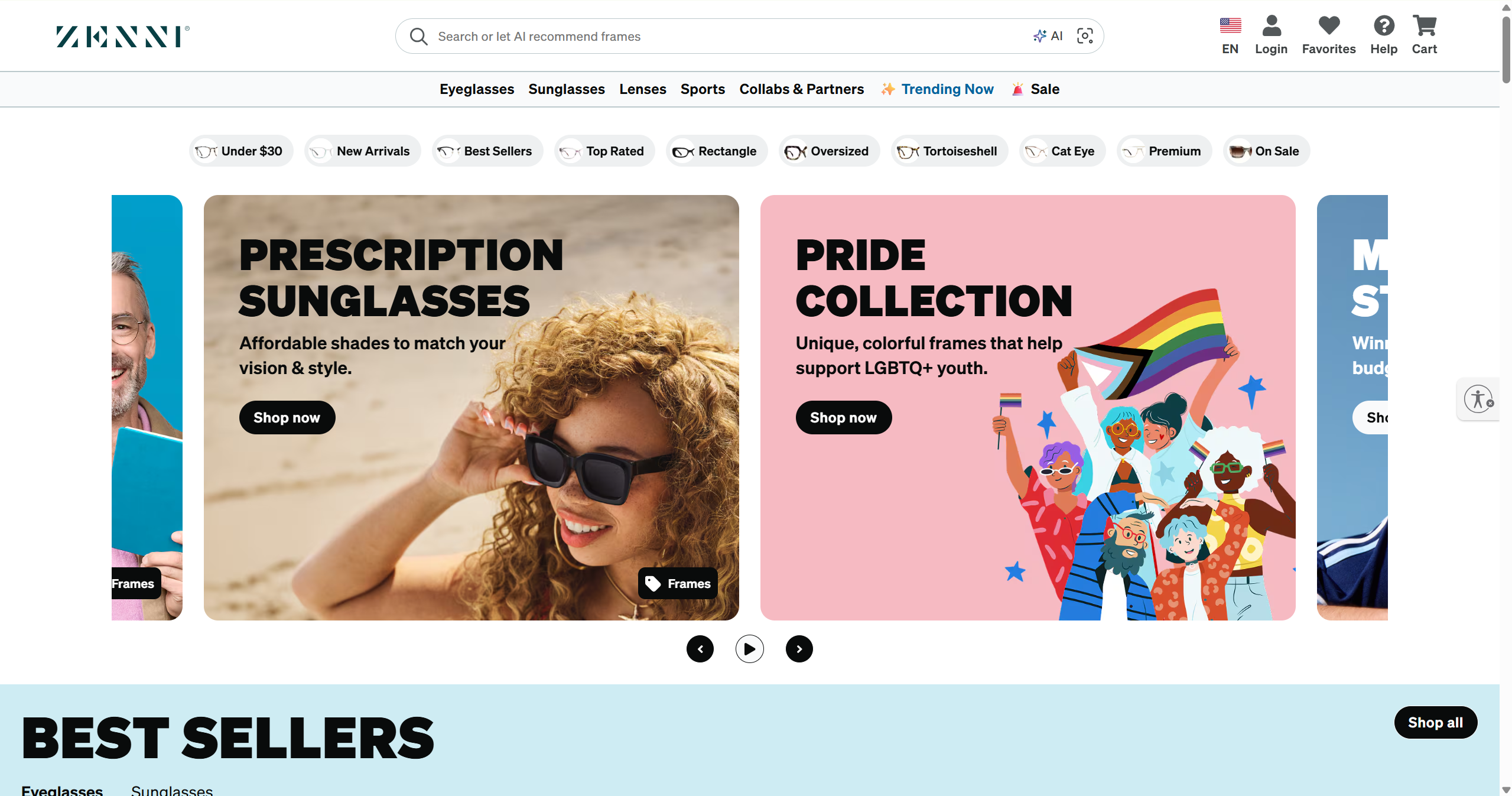
8. Zenni Optical — Best Affordable Glasses Try-On with PD Measurement [B2B]
Zenni Optical has built a strong virtual try-on experience that punches above its price point. Their web and mobile app VTO supports thousands of frames, and it includes a built-in PD measurement tool — which you'd normally need to get from an optometrist — making the entire glasses-buying process self-contained. Frame scaling is generally accurate, and you can toggle between different colors and lens options during try-on.
Despite its budget-friendly pricing, Zenni offers a surprisingly comprehensive virtual try-on experience, including PD measurement and interactive frame previews.
Key features:
Virtual try-on for thousands of eyeglass and sunglass frames
Built-in PD (pupillary distance) measurement
Frame color and lens option toggling
3D frame viewer with rotation and zoom
Pricing: Free (some frames start under $10).
Rating: 4.5 of 5 on Trustpilot with 165791 ratings.
Best for: Budget-conscious glasses shoppers who want to complete the entire purchase — including PD measurement — without leaving the app.
Limitations: Only for Zenni frames. No B2B option. Less realistic 3D rendering compared to Fittingbox. PD measurement tool is a helpful approximation but not a substitute for a professional measurement in complex prescriptions.
Best Virtual Try-On Apps for Watches & Jewelry
Virtual try on apps for jewelry and watches should mainly focus on accurate sizing, small details, and even real-time motion tracking.
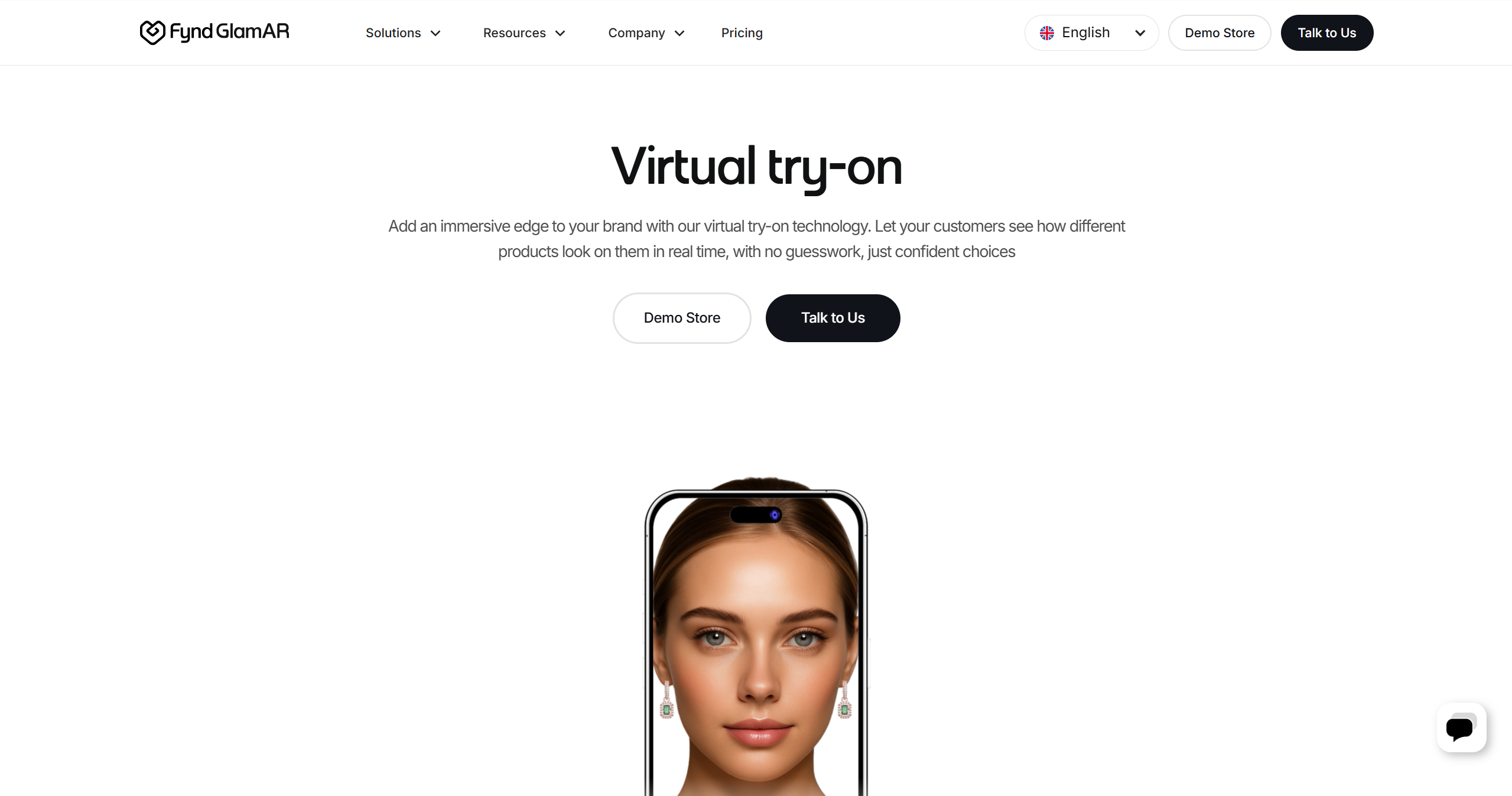
9. GlamAR — Best Multi-Category AR Try-On for Jewelry and Accessories [B2B]
GlamAR provides interactive AR virtual try-on across jewelry, eyewear, makeup, and accessories. For jewelry specifically, it offers realistic AR rendering and motion tracking, so necklaces, earrings, bracelets, and rings appear to move naturally as the user turns their head or moves their hands. The platform is API-based, meaning brands can integrate GlamAR's try-on into their own websites and apps rather than sending shoppers elsewhere.
Multi-category support makes GlamAR a strong choice for retailers selling across product types — a fashion brand that sells clothing, accessories, and eyewear can use one platform for all three.
Key features:
Real-time AR try-on for jewelry, eyewear, makeup, and accessories
Reflection and motion simulation for realistic jewelry rendering
API-based integration for brand-owned experiences
Supports necklaces, earrings, bracelets, rings, and watches
Pricing: Its virtual try-ons pricing plan varies monthly views and SKU limit. Contact for quote.
Best for: Multi-category fashion and accessories brands that want AR try-on across product types from a single provider.
Limitations: No self-serve pricing — require a sales conversation to get started. Smaller jewelry brands may find the custom integration cost prohibitive. Rendering quality may vary depending on lighting conditions, camera quality, and product complexity.
Best Virtual Try-On Apps for Makeup & Beauty
Beauty was the category to truly nail virtual try-on at scale, and it remains the most mature. Modern beauty VTO tools track facial features in real time, map products to skin tones with impressive accuracy, and work seamlessly across web, app, and in-store kiosks. Below are the top solutions for both beauty brands and consumers.
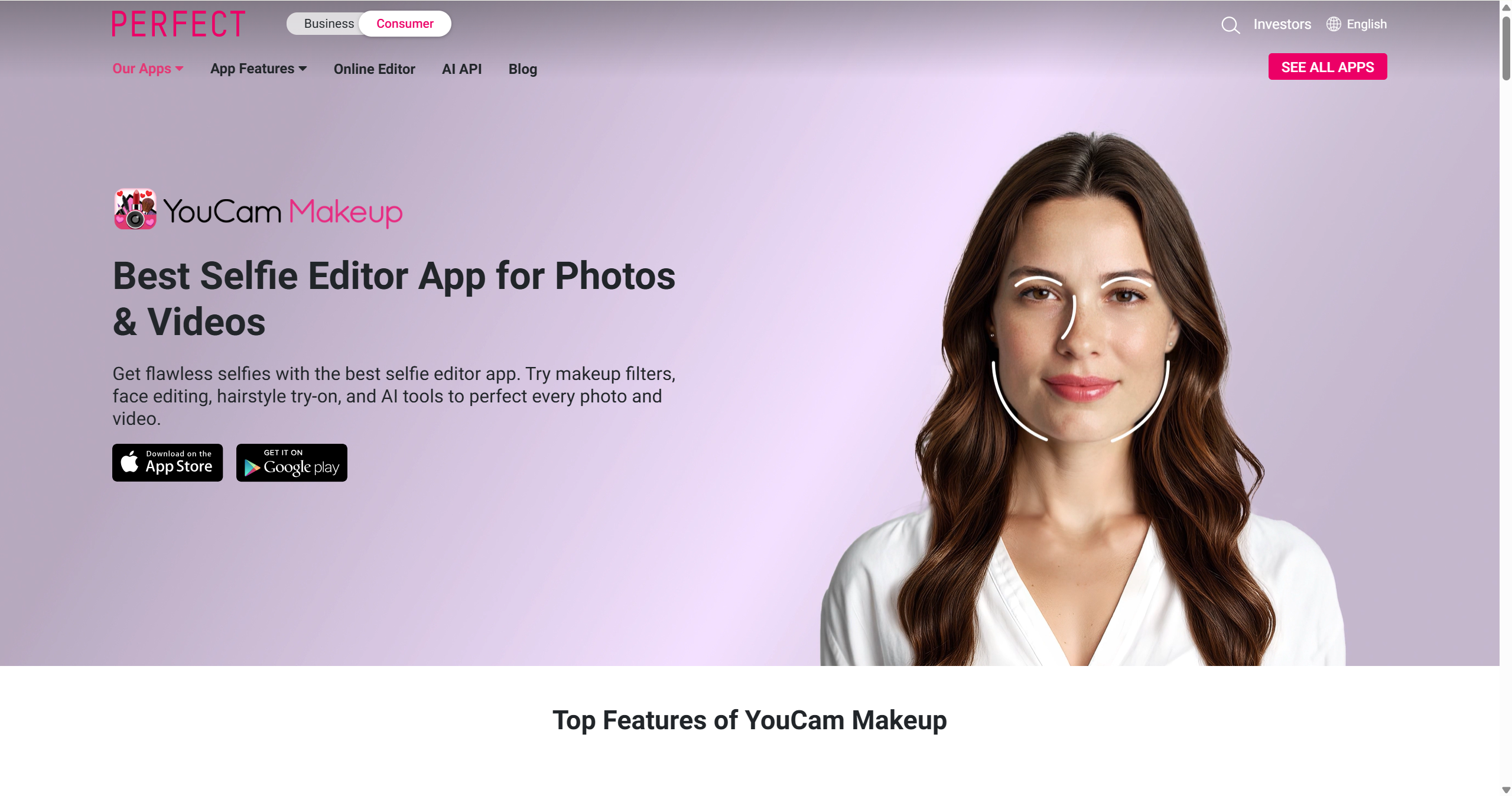
10. YouCam Makeup — Best Overall Beauty Virtual Try-On Platform [B2C]
YouCam Makeup is one of the world's most widely used beauty AR apps, with hundreds of millions of downloads globally. It provides with hyper-realistic makeup try-on across lipstick, eyeshadow, foundation, blush, and more. It also covers hair color (including real-time hair color and hairstyle try-on), and jewelry with motion simulation. Perfect Corp has also expanded into fashion, accessories, and eyewear virtual try-on experiences.
Key features:
Real-time AR makeup try-on with skin tone matching
360° hair color and style try-on
Eyewear VTO with automatic pupillary distance measurement
AI Skin Analysis for personalized skincare recommendations
Shopify and enterprise API integration
Pricing: Freemium for consumers (in-app purchases for premium features). Shopify and enterprise plans are available, with pricing varying based on SKU count and feature requirements.
Best for: Beauty brands and retailers who want the most comprehensive, battle-tested virtual try-on platform — and consumers who want one app that does it all.
Limitations: Shopify pricing starts high for small indie beauty brands. The consumer app's best features are behind a paywall. Enterprise integrations require significant setup investment.
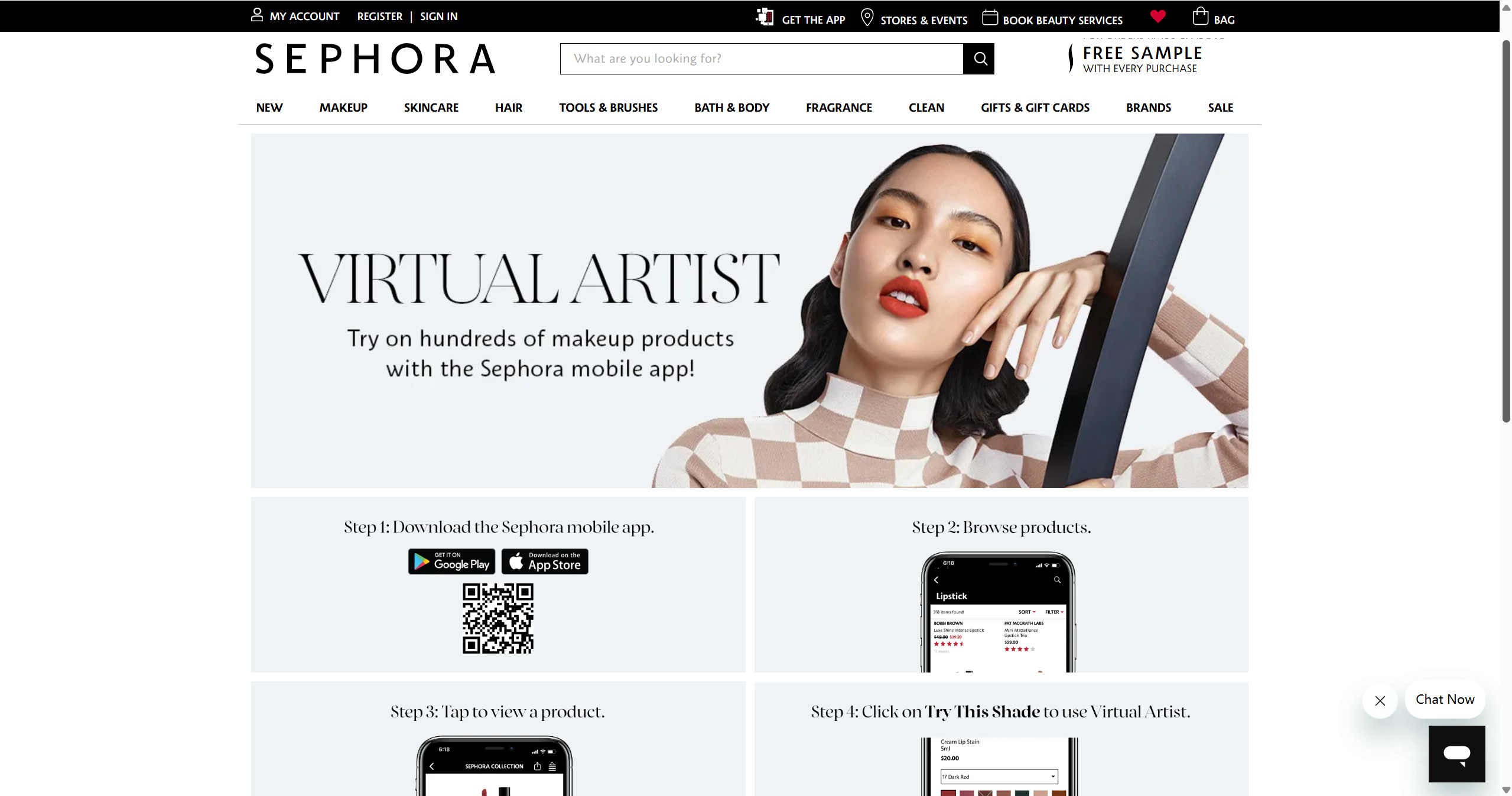
11. Sephora Virtual Artist — Best Multi-Brand Beauty Try-On Experience [B2C]
Sephora's Virtual Artist is baked right into the Sephora app and website, letting shoppers try thousands of products from hundreds of brands in one place. What makes it powerful is the breadth: you can try a Fenty lipstick, a NARS blush, and an Anastasia brow product all in the same session — then buy them in one cart. It also syncs with in-store scanners for hybrid shopping, so you can scan a product on the shelf and see it on your face instantly.
It is powered by ModiFace's AR technology. Shade matching is generally accurate, especially for lip and eye products.
Key features:
Try thousands of SKUs across hundreds of beauty brands
In-store scanner sync for hybrid shopping
Foundation shade finder
Virtual makeup tutorials and guided looks
Pricing: Free (requires Sephora account; products purchased through Sephora).
Best for: Beauty shoppers who want to test products across multiple brands before buying — and beauty brands that want distribution inside a high-intent shopping environment.
Limitations: Only works with products sold at Sephora. No standalone B2B option for brands to use on their own sites.
12. L'Oréal ModiFace — Best Enterprise-Grade Beauty Try-On Solution [B2B]
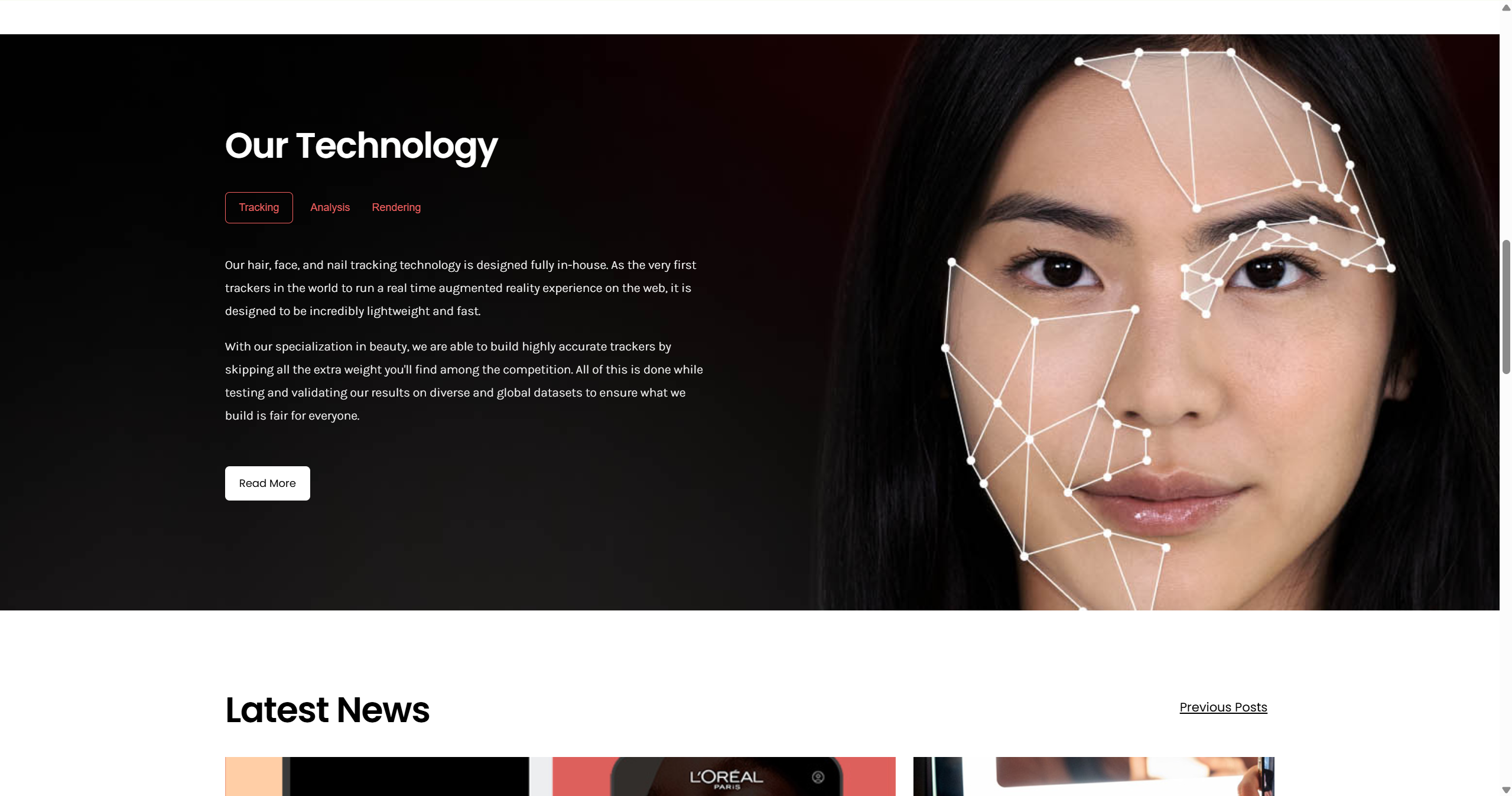
ModiFace is the engine behind many of the beauty VTO experiences you've already used — it powers try-on for L'Oréal's own brands (Lancôme, Maybelline, NYX, Urban Decay) and is licensed widely across the industry. Unlike consumer-facing apps, ModiFace is an enterprise SDK and platform: brands integrate it into their own websites, apps, and in-store experiences.
The technology is particularly strong in live video try-on, hair color simulation, and skin diagnostic tools. The platform supports live video experiences that allow brands to demonstrate products in real time.
Key features:
Live video try-on for makeup and hair color
AI-powered skin diagnostics
AI-powered shade matching and product recommendation tools
White-label SDK for brand-owned experiences
Pricing: Custom enterprise pricing — not publicly listed. Typically suitable for mid-to-large beauty brands.
Best for: Established beauty brands that want to own the virtual try-on experience on their own platforms.
Limitations: No self-serve option for small brands. Implementation requires development resources. The underlying technology is excellent, but the end-user experience depends heavily on how well each brand implements it.
How We Selected These Virtual Try-On Apps
We evaluated over 30 virtual try-on tools across four categories based on the following criteria:
Rendering realism: Does the output look convincing enough to drive purchase decisions? This includes fabric drape, skin tone matching, lighting consistency, and frame-to-face scaling accuracy.
Ease of integration: Can sellers add this to Shopify, WooCommerce, or their custom storefront without a development team? For consumer apps, is the UX intuitive?
Category specialization: A tool that does one thing well for a specific product type beats a generalist that does everything poorly.
Pricing transparency and value: Are the costs predictable? Does ROI math work for small businesses as well as enterprise brands?
B2B vs. B2C fit: Some tools are built for shoppers (consumer-facing try-on); others are built for sellers (on-model image generation and content creation). We've included both and clearly labeled which is which.
Only tools that demonstrated real-world adoption, active development, and meaningful differentiation made this list.
How to Choose the Right Virtual Try-On Tool for Your Needs
With 12 tools across four categories, the choice ultimately comes down to three questions:
1. What are you selling? This is the most important filter. Eyewear VTO (Fittingbox, Warby Parker, Zenni) is mature and reliable. Beauty VTO (YouCam Makeup, Sephora, ModiFace) is battle-tested and drives real conversion. Clothing VTO is the hardest category — if you're an apparel seller, prioritize tools like KOOZEE or Claid that focus on high-quality on-model generation rather than real-time AR overlays, which still struggle with fabric realism.
2. Who is your user — sellers or shoppers? Some tools generate content for your product pages (B2B: KOOZEE, Claid, Botika); others let shoppers try products on themselves (B2C: Google Shopping Try On, Genlook, YouCam Makeup consumer app). Some, like Perfect Corp and Fittingbox, do both. Be clear about which problem you're solving.
3. What's your budget and technical capacity? If you're a solo Shopify seller, start with a tool that has a free tier or low monthly cost and minimal setup (Genlook, Claid's entry plan). If you're a mid-market brand with development resources, API-based platforms (Perfect Corp, Fittingbox, GlamAR) give you more control and a branded experience. Enterprise brands should budget for custom integration and 3D digitization costs.
💡 Pro tip: Don't just look at the monthly fee. Factor in per-image credit costs, 3D digitization fees (for eyewear and jewelry), and the internal time needed to set up and maintain the integration. The cheapest tool on paper can become expensive if it requires constant manual input.
FAQs about Virtual Try-On Apps
Is virtual try-on worth it for e-commerce businesses?
Yes — with the right expectations. Virtual try-on won't eliminate returns entirely, but it consistently reduces them when using high-quality AI generation. The bigger gain is often in conversion rate: shoppers who use virtual try-on convert at meaningfully higher rates because they've already built mental ownership of the product.
What's the difference between AI virtual try-on and AR virtual try-on?
AR (augmented reality) virtual try-on overlays a 3D model onto a live camera feed in real time. It works well for rigid products like glasses and watches, but struggles with fabric. AI virtual try-on uses machine learning to generate a new image of the product on a person — it's not "live" but produces much more realistic results for clothing. Many modern tools use a hybrid approach: AI for generation, AR for real-time preview.
Which virtual try-on app is best for Shopify clothing stores?
For Shopify apparel sellers who need more than just try-on, KOOZEE offers a complete visual production workflow including on-model try-on, model/scene changes, product videos, and listing assets. For a lighter-weight, shopper-facing try-on widget, Genlook integrates directly into Shopify product pages. For batch on-model image generation, Claid works well with Shopify via API. The right choice depends on whether your priority is content creation (for your product pages) or shopper experience (for your customers).
How accurate is virtual try-on for clothing?
It depends heavily on technology. Real-time AR clothing try-on (where a garment is overlaid on a live video feed) is still limited — it can't realistically simulate fabric drape, stretch, or how a garment interacts with different body shapes. AI-generated try-on (where an image is created from your product photo and a model photo) is significantly more realistic, especially for showing how a garment looks "on body."
What should I look for when evaluating a virtual try-on tool?
Test one with your actual products. A tool that works beautifully for one category or garment type may fail on another.
Final Thoughts
If you're an e-commerce seller or brand in apparel, beauty, eyewear, or jewelry, the question isn't whether virtual try-on is worth it. The question is which tool fits your category, your budget, and your workflow — and how soon you can get it live.
This post reviewed 12 virtual try on apps across four categories. Compare them and choose one according to your products, budgets, and actual usage.